Hosting environments run on a basic assumption: an account with limited permissions should stay limited. CVE-2026-58048 breaks that assumption inside cPanel & WHM.
Any authenticated account with MySQL or MariaDB feature access, including a standard low-privilege hosting account, can now escalate to root-level database privileges through a database rename operation. A public proof-of-concept already exists, which means the barrier to exploitation is low and the window to act is short.
How the Database Rename Flaw Escalates to Root Access
Critical
9.4
Yes
Low
CVSS:4.0/AV:N/AC:L/AT:N/PR:L/UI:N/VC:H/VI:H/VA:H/SC:H/SI:H/SA:H
CVE-2026-58048 is a SQL injection and privilege escalation vulnerability in cPanel & WHM’s database management functionality, centered on the UAPI Mysql::rename_database function. The root cause is a failure to preserve SQL mode correctly during database rename operations. Normally, a command issued by a regular account runs with that account’s own restricted permissions. Because of this vulnerability, certain commands issued during a rename operation execute instead with the elevated authority of the database root user.
In effect, a hosting account that should only be able to touch its own database can trigger SQL statements that run as root. The consequence is not a minor information leak. It is full control over the MySQL or MariaDB instance, and on some server configurations, that database-level compromise can extend to OS-level compromise as well. For any environment where multiple customers or teams share a single cPanel instance, that turns one low-trust account into a potential entry point for compromising everyone else’s data on the same box.
The attack vector is authenticated and remote. An attacker only needs one working low-privilege account with MySQL/MariaDB feature access, which is a fairly common baseline permission on shared hosting plans. That combination, common access requirement plus catastrophic outcome, is what makes this vulnerability significant.
CVE-2026-58048: Affected Versions
| Detail | Value |
|---|---|
| Affected versions | cPanel & WHM, all supported versions prior to the security release builds |
| Also affected | WP Squared 138.1.6 and earlier |
| Authoritative patch guidance | support.cpanel.net vendor advisory for CVE-2026-58048 |
The vulnerable function is reachable over HTTP by any authenticated cPanel account with the relevant database feature access, so the exploitable surface is not limited to a narrow edge case. It applies broadly across cPanel deployments that expose MySQL/MariaDB management to end users, which is the default posture on most shared and reseller hosting setups. Because cPanel ships frequent security builds, treat the vendor advisory as the source of truth for exact patched build numbers.
CVE-2026-58048: Why This Vulnerability Matters
The risk here is concentrated in multi-tenant hosting. A web host, agency, or reseller running many customer sites on shared cPanel infrastructure typically hands out low-privilege accounts by design, on the assumption that those accounts are boxed in. CVE-2026-58048 removes that boundary. One compromised or malicious low-privilege account can escalate to root-level database access, which means exposure or manipulation of every database on that instance.
Blast radius: where OS-level compromise is possible on top of the database escalation, the impact extends beyond the database layer entirely, into the server itself.
For organizations running their own dedicated cPanel instance, the risk is narrower. Any internal team member, contractor, or automated service account with database feature access has a path to root if the instance is unpatched. That turns an ordinary internal permissions question into a full compromise scenario.
CVE-2026-58048: Mitigation Recommendations
Since the vulnerability lives inside cPanel’s own database management functionality, the following steps help reduce and contain exposure at every stage:
Apply cPanel’s official security release build
Apply it as soon as it’s validated in your environment. Refer to the vendor advisory for the exact patched build number, since this is the only complete fix for the underlying vulnerability.
Restrict the database rename feature for low-trust accounts
This is the specific feature the vulnerability abuses, so limiting who can invoke it directly reduces exposure until the patch is applied.
Audit MySQL/MariaDB feature access
Review which accounts currently have this access on shared or reseller hosting instances, and remove it from any account that doesn’t genuinely need it.
Review logs for unusual rename or privilege activity
Look particularly at accounts that don’t typically perform administrative database actions.
Segment high-value databases
Isolate them from shared multi-tenant instances where possible, so a compromised low-privilege account on one tenant can’t reach another tenant’s data even if escalation occurs.
Apply least privilege across all cPanel accounts
Review default permission templates so new accounts aren’t provisioned with database management access they don’t require.
Monitor vendor and community disclosures
Proof-of-concept exploits often evolve into refined attack techniques after initial publication.
Maintain and test database backups
So recovery is possible without paying a ransom or absorbing extended downtime if exploitation occurs before patching.
AppTrana Coverage for CVE-2026-58048
AppTrana customers are protected against exploitation of this cPanel vulnerability. It detects and blocks malicious requests targeting the vulnerable database rename function in cPanel & WHM, stopping privilege escalation before it can occur.
By intercepting these attempts at the edge, AppTrana helps limit the risk of unauthorized root-level database access and the broader compromise that can follow it. This gives hosting environments a protective layer while the vendor patch is validated and rolled out.
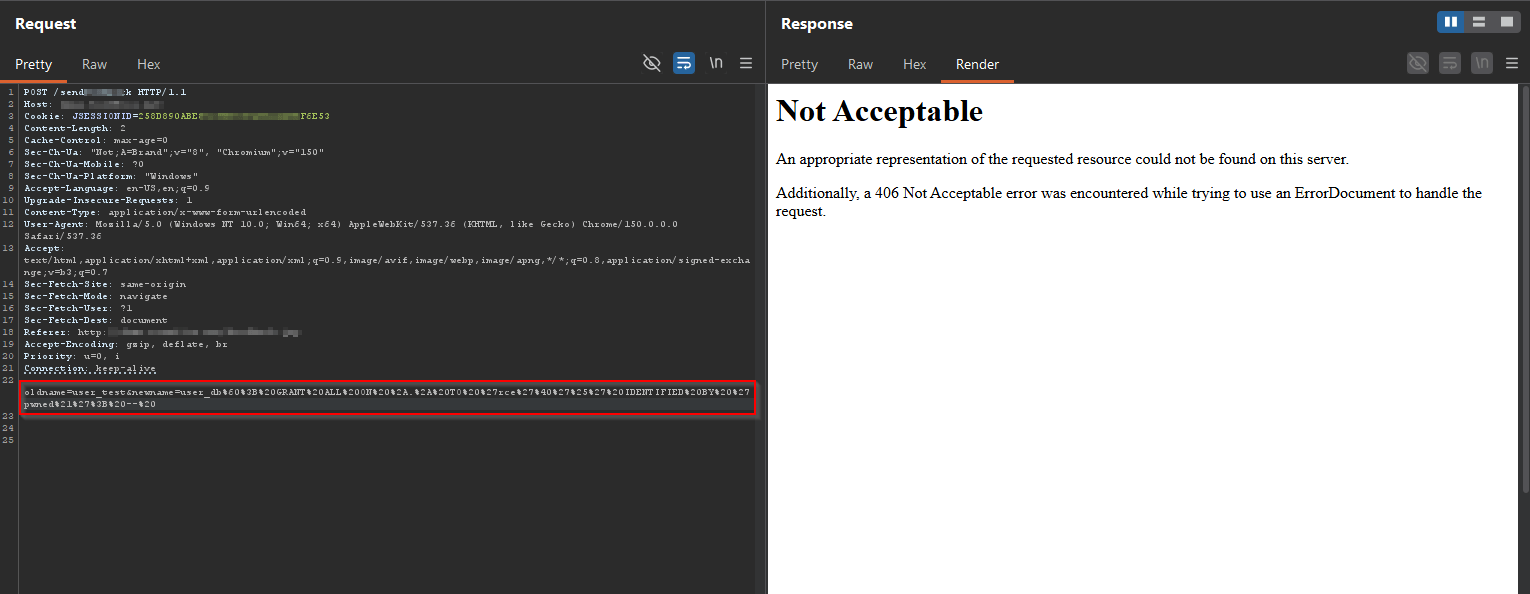
Block privilege-escalation attempts targeting CVE-2026-58048 while your patch rollout is validated.
Stay tuned for more relevant and interesting security articles. Follow Indusface on Facebook, Twitter, and LinkedIn.