A critical remote code execution vulnerability has been identified in Langflow. The vulnerability was first reported to the vendor in mid-2025 and disclosed publicly as a zero-day in January 2026. Exploitation attempts rose sharply in late August 2026, moving from isolated probing to continuous, multi-source scanning within days.
Langflow Code Injection/ Remote Code Execution Vulnerability
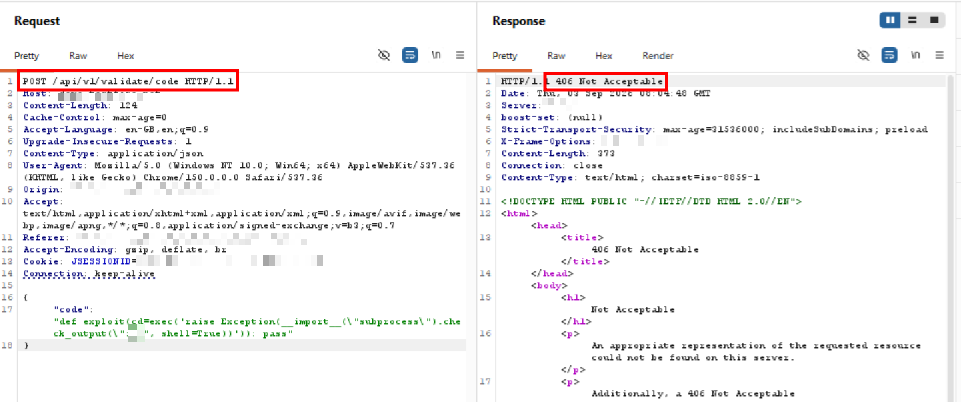
CVE-2026-0768 lives in Langflow’s custom component editor, specifically the validate endpoint that lets users test a code snippet before adding it to a flow. Langflow’s component model is built around user-authored Python. A component’s logic is meant to be arbitrary code that gets executed as part of a flow. The validate endpoint short-circuits that normal path. nstead of being staged, reviewed, and run only inside a controlled component execution context, a snippet submitted to validate skips that path. The code parameter is passed straight into Python’s exec(). The supplied code is processed through an unsafe code-execution path without an adequate sandboxing boundary.
In affected deployments where the endpoint is accessible without authentication, this can provide an unauthenticated code-execution primitive. The vulnerable execution path can allow attacker-controlled Python code to execute, potentially enabling command execution, filesystem access, and other actions available to the Langflow process.
If the Langflow service runs with root privileges, successful exploitation grants those privileges. The vulnerability is tracked as CWE-94: Improper control of generation of code.
The severity is compounded by two separate factors that are unrelated to the code vulnerability itself but shape real-world exposure:
- Authentication: In affected deployments where the endpoint is accessible without authentication, an attacker may be able to exploit the vulnerability without valid credentials.
- Autologin: Deployments using Langflow’s auto-login configuration may increase exposure by allowing access without explicit user authentication.
- Network Exposure: Internet-facing Langflow instances are at higher risk because the vulnerable endpoint may be remotely reachable.
- Network Segmentation: Lack of network segmentation can increase the potential impact by allowing a compromised Langflow instance to reach other internal systems.
In an affected deployment where the endpoint is accessible without authentication, an attacker may be able to send a crafted request and execute Python code with the privileges of the Langflow process. There is no second stage, chaining, or privilege escalation step needed.
What CVE-2026-0768 Affects
Langflow 1.4.2 is identified as an affected version. Confirm the affected/fixed version range against the latest vendor guidance before remediation. A comprehensive, vendor-confirmed fixed-version range has not been published at the time of writing.
What Has Happened Since Disclosure
Here is what security teams have observed in active exploitation attempts:
- In monitored environments, observed attacker behavior has included reconnaissance and credential focused activity. Requests probe for environment variables tied to superuser flags and cloud or AI provider API keys. They also attempt to read the application’s on-disk secret key and check for SSH access and shell history.
- Traffic sources have been geographically distributed. This indicates broad, non-regional exposure.
- Post-exploitation activity documented so far centers on credential and secret theft, including application secrets, cloud keys, SSH keys, and source code. This is followed by attempts at lateral movement and persistence, consistent with attackers using compromised instances as a foothold.
CVE-2026-0768: Patch and Remediation Steps
Work through the following steps in sequence to remediate exposure:
- Cut off internet exposure immediately – Remove direct internet access to Langflow instances and restrict reachability to trusted internal users and networks only. This is the high-priority mitigation for internet facing deployments.
- Check current vendor guidance before assuming an upgrade fixes it – No dependable fixed-version range has been confirmed publicly, so verify the latest advisory and hardening recommendations directly.
- Disable or restrict auto-login – Review the auto-login configuration and turn it off or require explicit authentication for API and validation requests.
- Lock down the validate/component-editor endpoint specifically – If the platform must remain reachable for legitimate use, restrict or gate this endpoint separately. It is the exact entry point being exploited.
- Check for signs of prior compromise – Review logs for requests to the code validation endpoint and unexpected Python or shell process spawns from the Langflow service. Also check for unusual reads of environment variables or secret files, and unexpected outbound connections from the host.
- Rotate exposed secrets – Treat any pre-existing credentials on an exposed instance as compromised, including application secret keys, embedded LLM or cloud provider API keys, and SSH keys. Rotate all of them.
AppTrana Coverage for CVE-2026-0768
AppTrana customers have been protected against exploitation from day zero. AppTrana provides autonomous protection for internet-facing Langflow deployments by inspecting requests to the code validation endpoint and blocking payloads that match known code-injection exploitation patterns. This gives teams a protective layer while they restrict exposure, apply current vendor guidance, and rotate credentials.
A blocked exploitation attempt targeting the Langflow’s validate endpoint, rejected by AppTrana.