What is Virtual Patching?
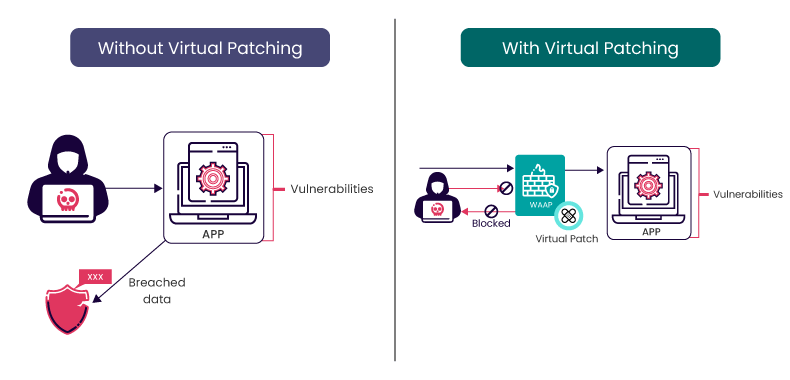
Virtual patching is a primary line of defense that blocks attackers from exploiting a known vulnerability in a web application or API, applied at the WAF without any change to source code. It keeps the application protected while developers ship the code fix through the normal sprint and release cycle. SEBI, RBI, and PCI DSS all recognize it as a documented compensating control.
Virtual Patching Example:
The video demonstrates Indusface’s managed service team’s rapid response to a reported zero-day vulnerability in the Spring Framework. They promptly addressed the Spring4Shell Remote Code Execution (RCE) flaw by creating a custom rule for zero-day virtual patching, accomplishing this within a 24-hour timeframe.
Why Virtual Patching Is Your First Line of Defense in 2027?
AI tools now surface high and critical vulnerabilities in hours. Development teams still close them in sprints, and sprints compete with product work. Attackers use the same AI to weaponize a new CVE before the fix reaches production. The result is a growing gap between finding a vulnerability and fixing it. Virtual patching closes that exposure window at the edge, so an open VAPT finding does not turn into a breach or an audit observation.
Three forces are widening this gap:
1. AI has turned vulnerability discovery into a flood
- In the first month of Anthropic’s Project Glasswing, about 50 partner organizations used an AI model to find more than 10,000 high- or critical-severity vulnerabilities (Anthropic, May 2026).
- Anthropic now says security progress is limited by how fast teams can verify, disclose, and patch vulnerabilities. Finding them is no longer the bottleneck.
- In May 2026, SEBI issued an advisory naming AI-driven vulnerability detection tools, such as Claude Mythos, as a new source of risk for regulated entities. It asks entities to apply virtual patching as an interim measure where patches are not available, and to plan long term for AI-based detection and autonomous mitigation ([SEBI circular HO/13/19/12(1)2026-ITD-1_CIMGI/10873/2026, May 5, 2026]).
2. Vendor patch releases keep getting larger
- Oracle’s July 2026 Critical Patch Update shipped 1,449 security fixes across 1,235 CVEs, the largest in its history
- Microsoft has said its patch counts will keep trending larger for some time (Anthropic, May 2026).
- Each patch still goes through testing, CAB approval, and a change window. For core banking, trading, and policy admin systems, that window rarely comes fast.
3. Attackers move faster than the release cycle
The Indusface State of Application Security 2026 report analyzed 10.54 billion attacks across 1,400+ AppTrana-protected applications in 2025:
- 6,235 zero-days were observed, 2.5x more than in 2024.
- LLM-assisted tooling lets novice attackers build working exploits for published CVEs within hours. The exploitation window has shrunk from weeks to days.
- API vulnerability exploitation rose 181% and website vulnerability exploits rose 56% year over year.
- 32% of critical vulnerabilities stayed open beyond 180 days. Development backlogs were the leading cause.
- Banking and financial services absorbed 2.72 billion attacks, up 113% year over year.
Real incidents confirm the speed. SharePoint CVE-2026-55040, went from public proof of concept to active exploitation within 24 hours.
For a CISO, this means higher vulnerability discovery, shorter remediation windows from regulators, and the same development capacity. Virtual patching protects the application at the edge while the code fix follows on the normal release cycle.
How Does Virtual Patching Work?
Virtual patching works by placing a targeted security rule at the WAF, in front of the vulnerable application. The rule inspects every incoming request and blocks attempts to exploit a specific vulnerability. Developers fix the code on their normal release cycle while the rule keeps attackers out.
Every virtual patch follows six steps:
- Find the vulnerability – Vulnerability findings come from VAPT reports, DAST scans, pen tests, bug bounty submissions, or vendor advisories for new CVEs. Each one is reproduced to confirm it is real and applies to your environment.
What to check: Business-logic vulnerabilities need testing beyond standard scanners. - Prioritize by risk – Rank each identified vulnerabilities by severity, how easily it can be exploited, and what the affected application handles. A high severity vulnerability on a payment or customer data API comes before a medium severity vulnerability discovered on a marketing site.
What to check: Priorities should reflect regulatory deadlines, such as SEBI’s one-week window for High severity vulnerabilities. - Create the rule – A WAF rule is written to block the exploit for that specific vulnerability. Strong rules decode the request first, so attackers cannot hide payloads with encoding tricks.
What to check: Rules should target the exploit behavior itself, such as the injection payload or the abused workflow step. - Test before blocking – The security rule first runs in log mode on live traffic and records what it would block. Any legitimate request it catches is tuned out before the rule moves to block mode.
What to check: A rule that blocks real customers causes more damage than the attack it stops. - Monitor and tune – Rules need attention after they go live. Application releases and new attack techniques can create gaps, so rules are reviewed and retuned regularly.
What to check: Zero-days do not wait for office hours. Make sure your virtual patches are backed by continuous, 24×7 monitoring, whether in-house or through a managed WAF. - Follow up and improve –Track how each virtual patch performs: how many attacks it blocks, what they target, and whether the rule needs tuning. Share block data with developers and IT teams so the riskiest vulnerabilities get fixed in code first. Record each patch as a compensating control for auditors and rescan once the code fix ships to confirm closure. Virtual patching works best as an ongoing cycle that improves with every finding.
What to check: Regulators such as RBI expect a fixed vulnerability to stay closed in the next scan.
Example: A VAPT finds a SQL injection in the accountId parameter of a bank’s statement API. The vulnerability identified is ranked high because the API exposes customer financial data. A rule is written to block any request where accountId is not a valid 12-digit account number. After a clean test in log mode, the rule moves to block mode. The injection payload never reaches the database. The identified vulnerability shows as protected in the audit report while developers fix the code.
Types of Virtual Patching Tools
Virtual patching runs on three types of security controls. For internet-facing web applications and APIs, such as net banking, trading platforms, policy portals, and SaaS apps, a WAF or WAAP is the standard choice. It reads every HTTP request in full and is already mandated by RBI, SEBI, and PCI DSS.
| Control | Where it runs | Best for | Limits |
| WAF / WAAP | In front of web apps and APIs, usually at a cloud edge | OWASP Top 10, OWASP API Top 10, and business-logic vulnerabilities | Covers only HTTP/HTTPS traffic routed through it |
| IPS / NGFW | At the data center perimeter or between network zones | Network and protocol-level exploits | Limited view of application logic and API workflows |
| Host-based controls (HIPS, RASP) | On the server or inside the application runtime | Legacy and internal systems | Needs an agent on every host; adds runtime overhead |
When Should You Use Virtual Patching?
Use virtual patching whenever an identified vulnerability is exposed to the internet and the code fix cannot ship inside the remediation window.
- High severity vulnerability with tight regulator deadlines – SEBI CSCRF expects high severity vulnerabilities closed within one week. A virtual patch keeps you compliant while the fix moves through the sprint.
- VAPT reports before an audit – Close open vulnerabilities at the edge so the report your auditor sees shows protected status for every item. Learn how a zero-vulnerability report helps you pass audits while code fixes are still in progress.
- Zero-days and new CVEs – Block exploitation before the vendor ships a patch, or while your team tests it.
- Development backlogs – Protect applications while identified vulnerabilities wait behind product releases.
- Vendor and outsourced applications – Protect core banking, LOS/LMS, policy admin, or ERP software you cannot change yourself.
- Legacy and end-of-life systems – Shield applications that no longer receive vendor updates.
- Systems that cannot go down – Protect payment, trading, and claims platforms without an emergency change window.
- Business-logic vulnerabilities – Block workflow abuse, such as amount tampering or IDOR on transaction records, that standard signatures miss.
Virtual Patching vs. Traditional Patching
Virtual patching protects the application now. Traditional patching removes the vulnerability from the code. Regulated teams use both, in that order.
| Virtual patching | Traditional patching | |
| What changes | A rule at the WAF edge | The application code or vendor software |
| Time to protect | Hours to days | Weeks to months: sprint, QA, CAB approval, change window |
| Downtime | None | Often needs a maintenance window |
| Developer effort | None at first | Full fix, review, and regression testing |
| Vendor dependency | None; works before a vendor patch exists | Waits on the vendor release |
| Audit evidence | Documented compensating control with block logs | Closed vulnerability after revalidation |
| Root cause | Stays in the code | Removed |
Benefits of Virtual Patching
Virtual patching gives security teams speed without forcing trade-offs on development, uptime, or compliance. Here are the key benefits for security and compliance teams:
- Shorter exposure window – Protection goes live within hours of a confirmed vulnerability. Code fixes often take weeks once you add development, QA, and CAB approval. Virtual patching removes that gap, so attackers lose the window between disclosure and the fix.
- No emergency releases – Developers fix the code on the normal sprint cycle, with full regression testing. Rushed hotfixes cause outages and new bugs. Virtual patching takes that pressure off the release team.
- Clean audit reports – Open vulnerabilities show as protected, backed by block logs your auditor can review. This helps you meet tight remediation windows, such as SEBI’s one-week deadline for high severity vulnerabilities, while the code fix is still in progress.
- No downtime – The rule deploys at the WAF, so the application never goes offline. Payment, trading, and claims platforms keep serving customers with no maintenance window.
- Protection for code you cannot change – Vendor products, outsourced applications, and end-of-life systems often cannot be patched quickly, or at all. A virtual patch protects them from the outside.
- Attack visibility – Block logs show who is targeting a vulnerability, how often, and from where. This evidence helps security leaders push the riskiest fixes up the development backlog.
Virtual Patching Checklist
Virtual patching works best with a few practices in place. Here are the key things to consider:
- Plan for the code fix – A virtual patch is a compensating control, and regulators still expect the vulnerability to be fixed in code. Track every virtual patch against a remediation ticket with an owner and a target date.
- Invest in rule quality – A rule is only as strong as the expertise behind it. Strong rules block the attack technique itself and get reviewed as attack methods evolve. A managed WAF brings in security experts who write and tune these rules for you, so quality does not depend on in-house bandwidth.
- Test before you block – A broad rule can block real customers and valid transactions. Run every new rule in log mode on live traffic first and move it to block mode only after a clean review.
- Route all traffic through the WAF – Virtual patching protects only the traffic that passes through it. Check that every internet-facing app and API, including new and shadow APIs, is routed through the WAF.
- Keep performance in check – Complex rules can add a few milliseconds to each request. Review your rule set periodically to keep it efficient as it grows.
- Plan for round-the-clock coverage – New zero-days and attack variants appear at any hour. Make sure someone is monitoring and tuning rules outside office hours, whether that is an in-house team or an expert partner.
Virtual Patching and Compliance
Regulators set firm remediation timelines and accept a documented compensating control while the code fix is pending. SEBI went a step further in May 2026 and named virtual patching directly.
| Regulation | What it expects | Where virtual patching fits |
| SEBI CSCRF | High severity vulnerability findings closed within one week (PR.MA.S3). The May 2026 AI advisory names virtual patching where patches are not available. | The interim control SEBI itself recognizes |
| RBI Digital Payment Security Controls | Time-bound remediation through a patch, compensating control, or approved risk acceptance (Clause 26) | A documented compensating control at the WAF |
| DPDP Rules, 2025 | Measures to detect and remediate unauthorized access to personal data (Rule 6), from May 13, 2027 | Remediates exposed apps and APIs without waiting for a release |
| PCI DSS v4.0.1 | Critical patches within one month (6.3.3) and automated prevention of web attacks (6.4.2) | Covers the patch window on the WAF that 6.4.2 already requires |
Virtual patching keeps you inside these windows. The code fix still follows on the normal cycle.
How to Compare Virtual Patching Solutions
Compare virtual patching solutions on six criteria: time to protect, accuracy, coverage, operating model, audit evidence, and cost. Ask each vendor the same questions and test them on your own open vulnerabilities.
| Criterion | What to ask the vendor | What good looks like |
| Time to protect | How long from a confirmed finding to a live block-mode rule? From a new critical CVE? | Hours, backed by an SLA |
| Accuracy | How is each rule tested for false positives before it blocks? | Log-mode testing on your traffic, with documented review |
| Coverage | Does it cover web apps, APIs, business logic, and vendor or legacy apps? | All four, through one platform |
| Scanner integration | Do scan findings turn into protection automatically? | Finding, rule, and closure tracked in one place |
| Operating model | Who writes, tests, and tunes rules? Is coverage 24×7? | A named expert team with round-the-clock monitoring |
| Audit evidence | What report do I get for my auditor? | Each vulnerability listed with severity, rule, and block status |
| Bypass resistance | How does the rule handle encoding tricks and direct-to-origin traffic? | Decoding before inspection, plus origin cloaking |
| Pricing | Do costs rise during an attack? Are custom rules or managed services extra? | Predictable pricing with services included |
Run a proof of concept. Pick three to five open findings from your latest VAPT report. Ask each shortlisted vendor to protect them. Measure three things: time to block mode, false positives on live traffic, and the quality of the audit report you receive. A real test on your own vulnerabilities tells you more than any datasheet.
How AppTrana Handles Virtual Patching
AppTrana’s SwyftComply AI closes the gap between finding a vulnerability and protecting it, in one continuous loop. AI handles vulnerability discovery and patching at machine speed. Security experts validate exceptions before it reaches live traffic.
- Find: inbuilt AI pen testing – AppTrana’s built-in DAST and AI pen testing scan your web apps and APIs. Multi-model AI agents probe business workflows the way an attacker would, so business-logic vulnerabilities surface alongside OWASP Top 10 and API Top 10 vulnerabilities.
- Patch: autonmous vulnerability remediation – SwyftComply AI autonomously applies proven policy templates to open vulnerabilities and deploys the virtual patches at the edge. Security experts verify exceptions. No code change or release is needed.
- Verify: tested before it blocks – Every virtual patch is tested against real application traffic and moves to block mode only after expert validation. Legitimate customers keep transacting while attackers get blocked.
- Comply: a zero-vulnerability report – Each cycle ends with a clean, audit-ready report that shows every open vulnerability is protected. You can share it directly with RBI, SEBI, IRDAI, or PCI DSS assessors as documented proof of compliance.
Close the exposure window. Start a free trial and stop attackers from exploiting your open vulnerabilities while developers fix the code.