From the helpful chatbots guiding us through customer service inquiries to the automated web crawlers indexing the vast expanse of the internet, bots have become an integral part of our digital landscape.
But what exactly is a bot, and how does it shape our online interactions?
According to many reports, bot traffic is almost 50% of internet traffic. Two-thirds of that is bad bot traffic.
In this blog, we will cover the definition of bots, how they evolved, the types of bots and finally how they impact us in our day-to-day lives.
What is a Bot?
A bot is a piece of software that carries out tasks on its own, following instructions a person or system gave it. It can browse, click, post, chat, or buy far faster than any human. Some bots are helpful. Others are built to cause harm.
Bots have evolved since the mid-1960s from early chatbots like ELIZA. Initially used for web indexing, they now serve diverse roles in social media and customer service, harnessing AI and NLP advancements.
Bots can be designed to interact with users, perform specific functions, or simulate human behavior.
How do Bots Work?
Bots work by executing automated tasks based on predefined instructions or algorithms.
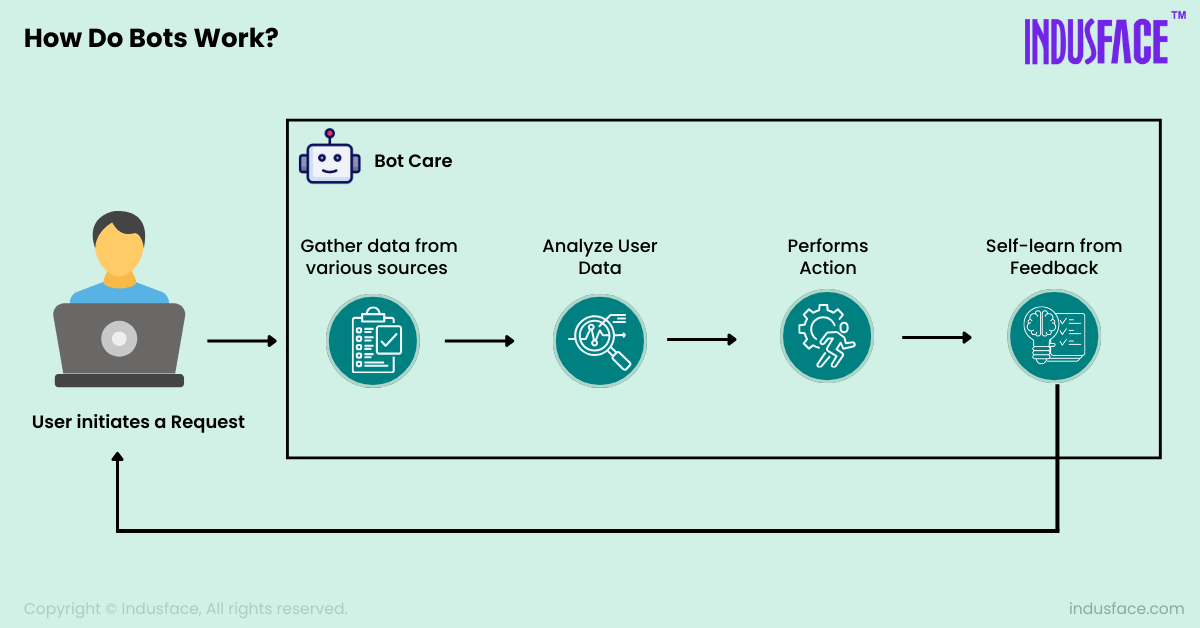
Here is a simplified explanation of how bots typically work:
1. Initialization: The first step is initialization either by a user or an automated system.
2. Data Retrieval: Once initialized, bots gather data from various sources, such as websites, APIs, databases, or messaging platforms.
3. Processing: Once the data is retrieved, the bots analyze the data, extract relevant information, make decisions, and generate responses based on predefined rules or machine learning models.
4. Action: Depending on the purpose, the bot may take various actions based on the processed data. For example, a chatbot may respond to user inquiries and a web crawler may index web pages for search engine results.
5. Feedback and Learning: With the advancements in AI/ML, bots now use machine learning to automatically improve over time by analyzing feedback. The feedback can come from user interactions, system metrics, or external data sources.
While this is one complete cycle, most bots repeat steps 1-5 in an endless loop or until a specified end goal has been met.
Types of Bots
At a high level, there are two kinds of bots: good bots and bad bots (malicious bots). Good bots work with permission and follow a site’s rules. Bad bots work without permission and break terms of service or security controls.
Good Bots
Good bots are designed to perform useful or beneficial tasks that enhance user experiences, streamline processes, or provide valuable services. They aim to assist users, automate repetitive tasks, improve efficiency, and deliver relevant information or functionality.
Real-World Applications and Examples of Good Bots
Chatbots
These bots engage in conversations with users, typically through text or voice interfaces. These range from commercial offerings on Intercom, Freshworks and the likes to consumer chat bots such as Alexa or Siri.
Web Crawlers
Bots that systematically browse the web to index or scrape content. Search engine bots such as Googlebot and Bingbot, pricing scraper bots such as PriceGrabber or PriceRunner and Dynamic Application Security Tools such as Indusface and Qualys are examples of web crawlers.
Trading bots
Automated programs that execute trades on financial markets based on predefined algorithms, often used in algorithmic trading and high-frequency trading.
They aim to capitalize on market inefficiencies and fluctuations to generate profits for traders and investors. In addition to crypto trading bots like Gunbot and HaasBot, there are also trading bots tailored for traditional financial markets, such as stocks and forex.
Monitoring bots
Bots used to monitor websites, servers, and networks for performance, and downtime. Monitoring bots play a vital role in ensuring the reliability and stability of digital services by alerting administrators to problems and facilitating timely troubleshooting and maintenance. Pingdom, Nagios, site24x7 are some examples of monitoring bots.
Utility bots
Utility bots provide a wide range of services on websites and messaging platforms, including helping businesses automate customer interactions when they create a digital catalog, while also serving as virtual assistants for users’ everyday needs. They use APIs to pull data from external sources and deliver information and services to users.
Bots used in various websites for services such as translation, weather updates and news fall in this category.
Malicious Bots
Bad bots are designed to perform malicious, harmful, or undesirable tasks that disrupt systems, exploit vulnerabilities, or deceive users. They aim to commit fraud, spread malware, steal sensitive information, manipulate data, or sabotage online operations.
Good bots operate with explicit authorization and adhere to legal and ethical standards, while bad bots operate without authorization and violate terms of service and security protocols.
Examples of Malicious Bots
- Account takeover bots: These bots test stolen usernames and passwords across many sites to break into accounts. This is called credential stuffing, and it leads to account takeover attacks.
- Brute force bots: These bots guess passwords at high speed until one works. Learn more about brute force attacks.
- Content scraping bots: Scraping bots copy prices, articles, or product data without permission, often for competitors or resellers.
- Scalper bots: Scalper bots buy limited stock like concert tickets or sneakers in seconds, then resell at higher prices.
- Carding bots: These bots test stolen credit card numbers with small purchases to find valid cards. See how a carding attack works.
- DDoS bots and botnets: A botnet is a network of infected devices under an attacker’s control. It floods a website with traffic until it slows down or crashes in a DDoS attack.
- Spam bots: Spam bots post fake comments, reviews, and form submissions.
- Click fraud bots: These bots click on ads to drain advertising budgets. Read more about click fraud.
- Probing bots: Probing bots scan websites for weak spots that attackers can exploit later.
AI Bots and the Rise of Agentic Traffic
AI has created a new class of bots. These bots read, summarize, and act on web content for AI models and the people using them.
AI bots fall into three groups:
- Training crawlers collect public web content to train large language models.
- AI search crawlers index pages so AI assistants can cite them in answers.
- User-triggered agents visit a page in real time when a person asks an AI assistant to fetch, compare, or book something.
Common AI Crawlers and What They Do
| Bot name | Operator | Purpose |
|---|---|---|
| GPTBot | OpenAI | Model training |
| OAI-SearchBot | OpenAI | ChatGPT search results |
| ChatGPT-User | OpenAI | User-requested page visits |
| ClaudeBot | Anthropic | Model training |
| Claude-SearchBot / Claude-User | Anthropic | Search and user-requested visits |
| PerplexityBot | Perplexity | AI search indexing |
| Google-Extended | robots.txt control for Gemini training use | |
| Meta-ExternalAgent | Meta | AI training and products |
| CCBot | Common Crawl | Open web dataset used by many AI models |
Controlling AI Bots
Site owners can allow or block each AI crawler in the robots.txt file. Blocking training crawlers keeps content out of future models. Allowing search crawlers helps a brand appear in AI answers. robots.txt is only a request. Well-behaved bots follow it. Malicious scrapers ignore it and fake the user agent of trusted AI crawlers. For options beyond a default block, see these WAF policies for AI crawlers.
Advantages and Disadvantages of Bots
Advantages
- Efficiency: Bots can perform tasks faster and more consistently than humans, leading to increased productivity and efficiency in various domains.
- 24/7 Availability: Bots can operate around the clock without the need for breaks or downtime, providing continuous support and services to users.
- Scalability: Bots can handle a large volume of requests simultaneously, making them well-suited for tasks that require scalability, such as customer support and data processing.
- Cost Savings: Bots can reduce operational costs by automating repetitive tasks and minimizing the need for human intervention, especially in areas like customer service and data entry.
- Accuracy: Bots can perform tasks with a high level of accuracy and consistency, minimizing errors and improving the quality of outcomes.
Disadvantages
- Overall, while bots offer numerous benefits in terms of efficiency, scalability, and cost savings, they also pose challenges such as:
- Lack of Human Touch: Bots may lack the empathy and understanding that human interactions provide, leading to less satisfying user experiences in certain situations, such as customer service.
- Complexity: Developing and maintaining bots can be complex and resource-intensive, requiring expertise in programming, artificial intelligence, and natural language processing.
- Dependency on Technology: Bots are reliant on technology infrastructure and may be susceptible to technical issues, such as system failures or software bugs, which can disrupt operations.
- Privacy and Security Concerns: Bots may raise privacy and security concerns, especially when handling sensitive data or interacting with users in sensitive contexts. Unauthorized access or misuse of bots can lead to data breaches and other security incidents.
- Limited Contextual Understanding: Bots may struggle to understand complex or ambiguous language, leading to misunderstandings and misinterpretations in conversations with users. They may also lack the ability to understand non-verbal cues and context, which can impact their effectiveness in certain scenarios.
How to Detect and Block Malicious Bots
Detecting bots can be challenging due to their diverse capabilities, evolving tactics, and ability to mimic human behavior.
However, when combined with measures such as honeypots and CAPTCHA challenges, behavioral analysis of the site traffic works best in detecting and blocking malicious bot traffic.
It is good to benchmark all traffic against the usual traffic pattern on parameters. Here is a sample list of questions on behavioral analysis:
1. How many requests do I receive from a single IP in a specific time period?
2. Is overall site traffic much higher than usual?
3. Is the IP listed in any malicious databases such as Spamhaus?
4. Do sessions from this IP show normal browsing behavior?
5. Do the requests from a specific user agent have supporting headers?
6. Is this much traffic from this region normal at this time of day?
Rate limiting helps stop bad bots by limiting how many requests they can make. By analyzing how traffic behaves, determine the optimal rate limits for your protection.
For websites that see the requests in large volume, investing in advanced bot management solutions with machine learning will help analyze anomalies in real-time and take mitigation measures promptly.
Check out top 13 Bot Management Software in the Market.
How do Bot Management Solutions Help?
According to many studies, bad bots contribute to almost 30% of internet traffic and they can lead to data breaches, loss of customer trust, compliance fines and many more unfavorable outcomes for businesses.
It is therefore prudent to invest in bot management solutions to filter out bad bots and protect applications from a variety of attacks including DDoS, scalping, scraping and so on.
About AppTrana’s Bot Management Capabilities
AppTrana WAAP provides behavioral bot protection with expert-backed operations built in. AI-assisted models score traffic behavior, then detect, validate, and contain bot anomalies automatically. You get protection against account takeover, card cracking, scalping and other attacks from day zero.
Machine learning for behavioral analysis and anomaly scoring combined with extensive false positive testing by the managed services team ensures that you filter out only bad bots.
Bots now target AI applications as well as websites. AppTrana blocks prompt injection, LLM endpoint abuse, and model scraping. It also detects automated agents that impersonate human traffic.
The managed services team helps with 24×7 anomaly monitoring and workflow-based security policies to block advanced business logic vulnerability attacks.
In conclusion, understanding bots and their various types is essential in today’s digital age. While good bots can greatly enhance user experience and efficiency, malicious bots pose significant risks. Investing in robust bot management solutions is crucial to safeguarding your applications and data.
Start a 14-day free trial today to experience the bot management capabilities on AppTrana WAAP.