Get Latest Zero-Day Vulnerability Report [PDF]
Unknown threats are the real risk. One such example is, Zero-day vulnerability, having been used in real-time attacks but not yet disclosed by the software vendor.
In H1 2026 alone, AppTrana WAAP identified 3,227 zero-day vulnerabilities across protected websites, every one blocked by default rule coverage with no manual intervention required.
What is a Zero Day Vulnerability?
Zero-day vulnerabilities refer to security flaws in software or hardware exploited by attackers before the developer becomes aware of them.
Unlike known vulnerabilities, which developers can patch with updates, zero-day vulnerabilities are particularly dangerous because there are no existing fixes or defenses.
The term “zero-day” stems from the notion that developers have zero days to prepare for an attack once the vulnerability is discovered. These vulnerabilities often originate during software development due to coding errors or design flaws.
However, they can also arise from reverse engineering, where attackers dissect software to uncover weaknesses.
AI and LLM Applications: A New Zero-Day Target Class
AI and LLM applications are emerging as a distinct target class for zero-day activity. Prompt injection, RAG data exposure, and agent-to-tool trust-boundary attacks are categories that didn’t meaningfully exist in a zero-day tracker two years ago. In H1 2026, their share of tracked zero-day activity grew 3x, a shift from traditional web app vulnerabilities toward a different set of weaknesses altogether. AI workflow and agent-orchestration tools are a particularly attractive target because they typically hold model-provider API keys, database credentials, and connector tokens in one place, so a single compromised instance gives an attacker a path to everything it’s connected to.
Zero Day Vulnerability Vs. Zero Day Exploits Vs. Zero Day Attack
“Zero-day” or “0-day” refers to the number of days since a vulnerability has been discovered, patched, or publicly disclosed.
When paired with terms like “vulnerability,” “exploit,” and “attack,” it provides a clearer understanding of the context and implications:
- Zero-day vulnerability refers to a flaw in software or hardware that is unknown to the vendor and remains unpatched. Attackers exploit these vulnerabilities before developers have had a chance to fix them, making them particularly dangerous.
- Zero-day exploit is software or code that uses a vulnerability for malicious actions. A zero-day exploit targets a zero-day vulnerability, allowing attackers to compromise systems, steal data, or cause harm before a patch is available.
- Zero-day attack: This term describes exploiting a zero-day vulnerability using a zero-day exploit. It highlights the proactive nature of the attackers who leverage unknown vulnerabilities to launch surprise attacks, often with devastating consequences.
Anatomy of Zero-Day Vulnerability
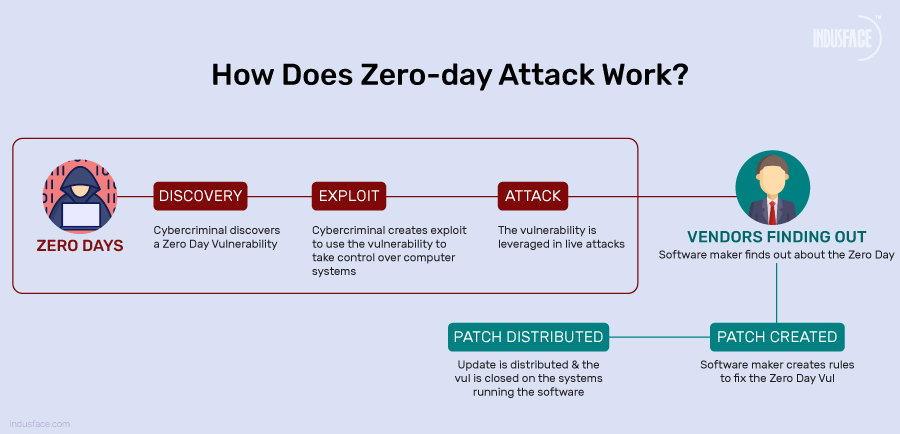
- Vulnerability Concealment: The vulnerability exists in software code but is unknown to the public and the software vendor.
- Vulnerability Discovery: It is found by a security researcher, hacker, or through automated tools during testing or analysis.
- Vulnerability Exploitation: Attackers use the vulnerability to gain unauthorized access or execute malicious code.
- Vulnerability Disclosure: The vulnerability becomes known to the software vendor or the public.
- Patch Development: The vendor works on creating and testing a fix or patch to address the vulnerability.
- Patch Deployment: Users and organizations apply the patch to their systems to protect against exploitation.
- Zero Day Attack Mitigation: Additional security measures reduce the risk until a patch can be applied to all systems.
Eventually, the vulnerability becomes obsolete as systems are patched or mitigated, but the impact may persist.
The Hidden Dangers of Zero Day Exploits
Zero-day exploits are like hidden traps in the digital world, waiting for the perfect moment to strike. Let’s uncover why they’re so dangerous in a way that’s easy to understand.
Surprise Attack
Zero-day exploits catch everyone off guard. Unlike known vulnerabilities, there’s no heads-up for software developers or security teams. Attackers can sneak in and cause chaos before anyone knows what’s happening.
No Defenses
Because they’re brand new, no shields are up against zero-day exploits. No patches, no updates, nothing. This opens computers, networks, and data for bad actors to exploit.
Significant Impact
When zero-day exploits hit, they hit hard. The impact of zero-day vulnerabilities can be disastrous, enabling attackers to execute a remote code, steal sensitive data, or disrupt critical systems. High-profile incidents like the Stuxnet worm and the Equifax data breach have underscored the devastating consequences of zero-day exploits.
Constant Battle
The fight against zero-day exploits is ongoing. It’s like a game of cat and mouse between the defenders and the attackers. Attackers are already looking for the next vulnerability as soon as one vulnerability is patched.
Examples of Latest Zero-day Attacks and Exploits
1. CVE-2026-0768 — Langflow AI Agent Builder RCE
Reported to the vendor in mid-2025 and disclosed publicly as a zero-day in January 2026. The flaw is in Langflow’s component validator, the validate endpoint meant to preview a code snippet before adding it to a flow. Instead of running inside a controlled component context, the submitted code is passed straight into Python’s exec() with no sandboxing boundary. In deployments where the endpoint is reachable without authentication, that is a single-request path to full code execution, no chaining or privilege escalation required.
Exploitation activity moved from isolated probing to continuous, multi-source scanning within days once attackers caught on. As an AI agent-orchestration tool, Langflow typically holds API keys, database credentials, and connector tokens, so compromise here extends well past the host itself.
2. CVE-2026-1281 & CVE-2026-1340 — Ivanti Endpoint Manager Mobile (EPMM)
Ivanti disclosed both critical code injection vulnerabilities on January 29, 2026, and confirmed they had already been exploited in a limited number of customer environments prior to public disclosure, the defining trait of a true zero-day. Both carry a CVSS score of 9.8 and stem from improper handling of Bash scripts in EPMM’s in-house app distribution and Android file transfer features, allowing unauthenticated attackers to execute arbitrary commands. CVE-2026-1281 was added to CISA’s Known Exploited Vulnerabilities catalog, and public PoC code accelerated broader scanning soon after.
3. CVE-2026-41940 — cPanel & WHM Authentication Bypass
A zero-day authentication bypass in cPanel & WHM, exploited in the wild before a patch was available. Given cPanel’s footprint across shared hosting environments, a bypass at the authentication layer opens the door to whatever an authenticated account, and by extension the hosting customers behind it, would normally be restricted from reaching.
4. CVE-2026-35273 — Oracle PeopleSoft
An actively exploited zero-day in Oracle PeopleSoft, used against production environments before Oracle shipped a fix. PeopleSoft’s role in HR and financial operations for large enterprises makes it a recurring target for attackers seeking access to sensitive employee and financial data, and zero-days in the platform tend to have a long tail of exposure given how slowly some organizations patch ERP systems.
5. SharePoint Zero-Day — Microsoft’s July 2026 Advisory
Disclosed alongside a Copilot RCE and an Entra SSRF vulnerability in the same advisory cycle, this SharePoint flaw was exploited as a zero-day ahead of Microsoft’s fix. Bundled disclosures like this one are common for Microsoft’s larger platforms, but the SharePoint component specifically carried active exploitation risk from day one, distinct from the Copilot and Entra issues disclosed alongside it.
Track these and other emerging threats in our ongoing security bulletins.
Who Discovers Zero Day Vulnerability?
Zero-day vulnerabilities can be discovered by various entities, including:
Independent Security Researchers: Individual researchers or groups often uncover zero-day vulnerabilities through independent efforts, either by analyzing the software code, conducting security assessments, or participating in bug bounty programs.
Security Companies: Dedicated cybersecurity firms and companies specializing in vulnerability research actively search for zero-day vulnerabilities as part of their security research efforts. These companies may discover vulnerabilities through automated scanning, manual code analysis, or targeted research.
Government Agencies: Government agencies, particularly those involved in intelligence and national security, may discover zero-day vulnerabilities through their own research and monitoring activities. These vulnerabilities may be used for defensive purposes or exploited in offensive cyber operations.
Hackers and Cybercriminals: Unfortunately, malicious actors also play a role in discovering zero-day vulnerabilities. Some hackers and cybercriminals actively search for vulnerabilities to exploit for personal gain, such as financial profit, espionage, or sabotage.
Bug Bounty Programs: Many software vendors and technology companies run bug bounty programs that incentivize security researchers to report vulnerabilities they discover. These programs offer rewards, such as cash prizes or recognition, for responsibly disclosing vulnerabilities, including zero-day issues.
How to Identify Zero-Day Vulnerability?
Vulnerability Scanning
Vulnerability scanning is an essential aspect of cybersecurity, particularly in detecting zero-day attacks. Organizations can proactively identify vulnerabilities by systematically assessing systems and networks for potential weaknesses, including those previously unknown to software vendors.
This proactive approach enables early detection and mitigation of 0-day threats, allowing organizations to prioritize patches and security updates to prevent exploitation.
Organizations must be quick to act on the results of such a scan because attackers tend to act quite fast on vulnerabilities they find.
Behavioral Anomalies
Monitor network and system behavior for unusual patterns or activities that deviate from normal operations. This includes unexpected network traffic, unusual system resource usage, or unauthorized access attempts.
Signature-less Detection
Implement advanced threat detection techniques, such as anomaly detection and machine learning algorithms, that can identify suspicious behavior without relying on known attack signatures.
Threat Intelligence
Leverage threat intelligence feeds and information-sharing communities to stay informed about emerging threats and zero-day vulnerabilities. Proactively monitor for indicators of compromise (IOCs) associated with zero-day attacks and take appropriate action to defend against them.
Sandboxing and Emulation
Employ sandboxing and emulation techniques to analyze suspicious files or executables in isolated environments. By observing the behavior of these files in a controlled setting, you can identify potential zero-day exploits before they can cause harm.
User Behavior Analytics (UBA)
Monitor user activity and access patterns to detect abnormal behavior or unauthorized access attempts. UBA solutions can identify anomalies that may indicate the presence of a zero-day attack, such as unusual login locations or privilege escalation attempts.
Continuous Monitoring and Incident Response
Implement robust monitoring practices and incident response procedures to detect, investigate, and mitigate zero-day attacks in a timely manner. Regular security audits, penetration testing, and tabletop exercises can help prepare organizations to respond effectively to zero-day threats.
How to Protect from Zero-Day Attacks?
Here are best practices to protect your systems from 0-day attacks and enhance your zero-day protection:
Stay Up to Date
Ensure your software, operating systems, and applications are regularly updated to the latest versions. Vendors regularly release patches to fix known vulnerabilities, including zero-day exploits.
Implement Security Patches Quickly
Applying patches quickly whenever vulnerabilities are discovered is very important. It reduces the risk of an attack and sends signals to attackers that the developers are constantly looking to improve security. Efficient patch management depends on software users’ speed of development and applications.
Add virtual patching as part of your patch management strategy. Most WAFs automatically apply virtual patches to the application when vulnerabilities are identified.
Utilize Endpoint Protection
Deploy endpoint protection solutions, such as antivirus software and intrusion detection systems, to detect and prevent malicious activity on individual devices. These solutions can help identify and block zero-day exploits before they can cause harm. For organizations or individuals looking to strengthen device-level security, resources like Cybernews’ Avast coupon codes can help make reliable antivirus protection more accessible.
Implement Least Privilege Access
Limit user privileges and access rights to only those necessary for performing job functions. This reduces the impact of potential zero-day attacks by minimizing the attack surface and limiting the scope of compromise, contributing to zero-day protection and mitigation strategies.
Educate Employees
Train employees on cybersecurity best practices, such as identifying phishing emails, avoiding suspicious links and attachments, and reporting security incidents promptly. Zero-day attacks often exploit human error, so awareness training is essential.
Use Network Segmentation
Segment your network into separate zones with different security levels to contain the spread of attacks and limit the impact of breaches. This can help prevent lateral movement by attackers and mitigate the damage caused by zero-day exploits, enhancing overall zero-day mitigation efforts.
Incident Response Plan
Given the financial, operational, and reputational damage that zero-day exploits can have on an organization, it would be advisable to have an incident response plan. The plan should help detect attacks faster, limit the damage, and recover as quickly as possible.
Zero-day Attack Mitigation with AppTrana WAAP
Vulnerability scanning and patch management only provide partial solutions to zero-day attacks. The time taken to develop and apply patches and code fixes often creates a large window of vulnerability.
The DAST Scanner bundled in AppTrana WAAP actively tracks an organization’s overall security posture, providing continuous insights into potential risks, including zero-day vulnerabilities.
Autonomous remediation, powered by SwyftComply AI, extends this further. Autonomous protection applies a targeted virtual patch automatically, closing the exposure window for many classes of vulnerability. This matters most for zero-days specifically, since there is no vendor patch to fall back on in the interim. Teams still review and can override what gets applied, but the default posture is protection first rather than a queue of manual triage.
Reducing exposure time for zero-day vulnerabilities hinges on the WAAP vendor’s update and patch timeliness.
The video illustrates how Indusface’s managed service team promptly reacted to a zero-day vulnerability in the Spring Framework using virtual patching.
Indusface security researchers constantly monitor the security landscape and lead security websites to identify any new vulnerabilities identified/published and monitor/update rules to ensure around-the-clock protection for customer sites from day zero.
Stay tuned for more relevant and interesting security articles. Follow Indusface on Facebook, Twitter, and LinkedIn.