Enterprises running Adobe ColdFusion often carry legacy development features forward long after the original use case is gone. Remote Development Services (RDS) is a good example: a convenience feature that lets an IDE talk to a live ColdFusion server, left switched on from an old dev workflow years after anyone remembers why.
CVE-2026-48282 shows what that forgotten setting costs. It is an unauthenticated path traversal vulnerability in ColdFusion’s RDS component that escalates to full remote code execution, and public exploitation was observed within hours of technical details becoming available. It is a live campaign, and a reminder that admin-facing services left reachable from the internet are exactly the kind of surface attackers scan for first.
What Is CVE-2026-48282: The ColdFusion RDS Path Traversal Vulnerability
CVE-2026-48282 is a path traversal vulnerability in Adobe ColdFusion’s Remote Development Service that allows unauthenticated attackers to exploit the vulnerable /CFIDE/main/ide.cfm endpoint, potentially resulting in arbitrary file operations and leading to remote code execution. No authentication or user interaction is required for exploitation under vulnerable configurations.
Researchers found that insufficient path validation in the RDS FILEIO functionality allows attacker-controlled paths to escape the intended directory boundaries, potentially enabling arbitrary file operations outside the expected directories.
Affected Versions and Configuration Risks
All ColdFusion versions 2025.9, 2023.20, and earlier are affected. Adobe shipped fixes in ColdFusion 2023 Update 21 and ColdFusion 2025 Update 10, released June 30, 2026.
Risk concentrates on a specific configuration. Exploitation requires RDS to be enabled, which it is not by default, and RDS authentication to be disabled. That narrows the exploitable population, but legacy or forgotten dev-server configurations left internet-facing are exactly where this setting tends to survive unnoticed.
Technical Root Cause: Arbitrary File Write via Broken Path Validation
Two things combine to make this exploitable. First, the RDS FILEIO handler trusts attacker-supplied file paths without properly constraining them to the intended directory. Second, when RDS authentication is off, that handler is reachable by anyone who can send it a request, no credentials required.
Public technical analysis describes CVE-2026-48282 as enabling arbitrary filesystem writes under vulnerable configuration, which ultimately results in remote code execution. Under vulnerable configurations, the attacker can write executable CFML files directly into the ColdFusion web root, which is what converts a file-write bug into full code execution the moment the server processes that file as a request.
Why This ColdFusion Vulnerability Is Dangerous for Enterprise Web Infrastructure
ColdFusion servers are rarely isolated. They typically sit in front of production applications with live database connections, stored credentials, and integration points into other internal systems. Once arbitrary file write is achieved, attackers may execute operating system commands, access sensitive configuration files, and obtain application and database credentials stored on the box. None of which requires anything beyond the initial file-write primitive.
Inside the Attack Chain: From Exposed RDS Endpoint to Remote Code Execution
Fingerprint exposed ColdFusion instances
The Shadowserver Foundation tracks roughly 750 internet-facing ColdFusion servers, a population attackers can scan and fingerprint for RDS availability directly.
Send crafted path traversal request
In one captured attempt, the attacker sent a crafted RDS payload targeting the FILEIO handler to read C:\Windows\win.ini, a canary check used to confirm the target is exploitable before deeper action.
Escalate from file read to file write
Once exploitability is confirmed, the same path traversal vulnerability allows the attacker to write files into directories outside the intended RDS sandbox.
Drop executable CFML into the web root
The attacker may write malicious executable CFML files into a web-accessible directory, which ColdFusion may execute as a normal application request, completing the path to remote code execution.
Active Exploitation Timeline
Adobe released the patch on June 30, 2026, stating it was not aware of any exploits in the wild but assigning the update a priority rating of 1 given the high risk of exploitation.
Exploitation attempts were detected on July 2, less than two hours after technical details of the vulnerability became public.
Indicators of Compromise to Monitor
Organizations running affected ColdFusion versions should review for:
- Unexpected or unauthorized
.cfmfiles inside the web root — Check file creation timestamps against your normal deployment schedule. Any.cfmfile that appeared outside a known release window deserves inspection, especially in directories your team doesn’t normally write to. - Unfamiliar files under
/CFIDE/directories — This includes new subfolders, renamed files, or files with obfuscated or unusual names./CFIDE/is an administrative path, so legitimate content there rarely changes outside of upgrades. - Requests to
/CFIDE/main/ide.cfmfrom unrecognized IP addresses — This endpoint has no legitimate reason to receive traffic from the public internet in most production setups. Any hits from IPs outside your known developer or internal ranges warrant a closer look. - Read attempts against system files such as
win.inior/etc/passwdin access logs — These are common canary checks attackers use to confirm a target is exploitable before attempting file writes. Seeing one, even without evidence of further activity, means the server was probed and should be treated as a possible entry point. - RDS traffic on instances where RDS was believed to be disabled or unused — If your team’s understanding is that RDS is off, but logs show RDS-related requests reaching the server, that mismatch itself is a signal worth investigating, either a misconfiguration or an indication the service is reachable when it shouldn’t be.
- Outbound connections or newly spawned processes following any of the above — Since this vulnerability can lead to full code execution, also check for unfamiliar outbound network connections, unexpected scheduled tasks, or new processes running under the ColdFusion service account around the time any suspicious request was logged.
Mitigation Guidance for CVE-2026-48282
The following steps should be followed in order, starting with the patch and moving through configuration hardening to compromise assessment.
Patch immediately
Upgrade to ColdFusion 2025 Update 10 or ColdFusion 2023 Update 21. Treat this as a priority-one patch given the CVSS 10.0 rating and confirmed active exploitation.
Disable RDS if it isn’t actively used
RDS is off by default for a reason. It exists to support IDE-to-server debugging during active development. Most production servers have no ongoing need for it. Audit every ColdFusion instance in your environment, including staging and legacy servers that may have been provisioned years ago, and turn RDS off wherever it isn’t a documented, active requirement.
Enforce RDS authentication wherever RDS is required
If a genuine development or debugging use case still needs RDS enabled, never run it with authentication disabled on a server reachable from the internet. Set a strong RDS password, and where possible, restrict RDS access further with network-level controls such as IP allowlisting, so that even authenticated RDS traffic can only reach the server from trusted source ranges.
Assume compromise on any exposed instance
If a server was internet-facing with RDS enabled at any point before you patched, don’t treat patching alone as closure. Review the web root and /CFIDE/ directories for unauthorized files. Check application and access logs for the indicators above, going back at least two to three weeks. Rotate any credentials, API keys, or database passwords stored on or accessible from that server. If you find evidence of a dropped .cfm file or unexplained process activity, treat it as a confirmed compromise and follow your incident response process.
How AppTrana Helps Against CVE-2026-48282 Exploitation Attempts
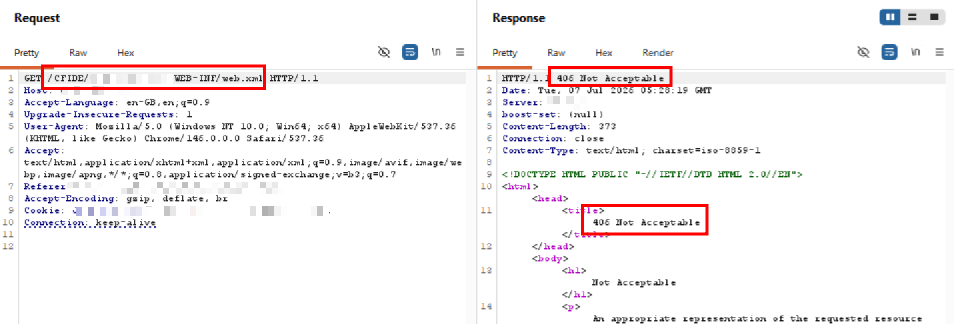
AppTrana customers were protected against exploitation attempts for CVE-2026-48282 from day zero. The platform identifies and blocks malicious requests targeting the vulnerable /CFIDE/ endpoints, including path traversal attempts commonly used to exploit this vulnerability. This provides an immediate layer of defense while security teams validate and deploy Adobe’s official patches.
As shown below, AppTrana intercepts the malicious request and blocks it with a 406 Not Acceptable response, preventing exploitation of the vulnerable endpoint.
Stay tuned for more relevant and interesting security articles. Follow Indusface on Facebook, Twitter, and LinkedIn.