

Top AWS WAF Alternatives in 2026
 February 13, 2025

 ChatGPT
Amazon Web Services (AWS) is one of the most widely used cloud platforms for running websites, APIs, and internet-facing applications. AWS WAF is a native web application firewall that helps protect these workloads from common web exploits, bots, and abusive traffic patterns, and it integrates with services like CloudFront, Application Load Balancers, and API Gateway.
AWS WAF is a strong choice for many teams because it fits naturally into an AWS-first stack and can be deployed quickly with infrastructure-as-code, logging, and governance controls. For SMBs, it is often the fastest path to baseline WAF protection inside AWS without adding another vendor. For enterprises, it is commonly adopted to standardize controls across multiple applications and environments while aligning with the broader AWS security ecosystem.
Disclosure and perspective: Our observations in this guide are based on public documentation and anonymized patterns we see during customer migrations away from AWS WAF across different team sizes and operating models.
If you are reading this guide, the intent is likely not “is AWS WAF good?” The intent is that your requirements changed. The most common trigger we see is that the operational burden and risk tolerance shift as traffic grows, APIs expand, compliance expectations rise, and false positives become more expensive.
Short on time? Jump to the 30-Second Decision Guide below to pick the right operating model first, then use the comparison table and vendor sections to shortlist options.
Below are the most common reasons teams reassess AWS WAF, split by what typically shows up in enterprise vs SMB environments.
Reasons Why You Might Want to Switch from AWS WAF
Most switches are not because AWS WAF is “bad.” Teams usually switch when the operating model stops matching how much time, expertise, and risk tolerance they can realistically dedicate to WAF operations.
Two patterns show up repeatedly:
- Enterprise teams switch when they need an outcome-owned operating model with predictable workflows for tuning, incident handling, and audit-ready reporting, even if they have strong AWS expertise internally.
- SMB and scale-up teams switch when AWS WAF becomes a DIY program that they cannot staff consistently. They need faster time to enforcement, fewer false positives, and less operational overhead.
DDoS readiness becomes a program, not a feature
Amazon Web Services DDoS protection often starts with AWS Shield Standard as a baseline for common events. Teams reconsider their setup when they need advanced protections, more predictable escalation, or a stronger incident-handling workflow during attacks. At that point, AWS Shield Advanced is commonly evaluated, and the commercial model becomes part of the decision.
AWS documents that Shield Advanced has a $3,000 monthly fee with a 1-year subscription commitment, and also includes Shield Advanced data transfer usage fees for resources enabled for advanced protection.
This is where some teams prefer a WAAP model where DDoS monitoring and incident execution are delivered as an outcome, rather than a separate program to subscribe to, configure, and operationally run.
Enterprise trigger: You need predictable incident workflows and response expectations across multiple apps and business units, not ad hoc runbooks that vary by team and service.
SMB trigger: You can’t afford to “build a DDoS program” on top of your WAF. You need 24×7 monitoring and guided mitigation as part of the service, not a separate escalation path you only discover during an incident.
False positives on managed rules
AWS WAF gives you strong building blocks, including AWS Managed Rules (managed rule groups), partner rule groups(Fortinet, F5 etc.), and custom rules. The hard part is operating them safely in production. False positives are rarely solved by “better rules” alone. They require ongoing tuning: testing changes on real traffic, adding exceptions, validating business logic flows, and monitoring impact after each update.
Many teams start in monitor or count mode to reduce disruption, then remain there longer than intended because the operational bandwidth to tune safely is not available. When false positives become expensive, the question becomes operational: who owns continuous false-positive reduction, how fast changes are made, and how reliably you can reach and maintain stable block mode without breaking business-critical paths.
This is also where buyers confuse managed rules with managed outcomes. Managed rules reduce the effort of writing detections from scratch, but they do not remove the need to validate, tune, and respond. Teams that want a managed outcome often look for providers that take responsibility for ongoing tuning, validation, and incident response, not just the ruleset.
Enterprise trigger: False positives become revenue and credibility risks. The requirement becomes operational ownership: who tunes continuously, how fast changes are made, and how reliably you can stay in stable block mode.
SMB trigger: Security is a part-time responsibility, so tuning never catches up. The WAF stays in count/monitor mode longer than intended or gets loosened to reduce disruption.
If you are switching because of recurring false positives, prioritize alternatives that include owned onboarding to block mode and continuous tuning as part of the service.
Request body inspection limits create real coverage gaps for APIs
Modern applications and APIs commonly carry large JSON payloads. AWS WAF body inspection limits vary by the protected resource type. AWS documents that for Application Load Balancer and AWS AppSync, the limit is fixed at 8 KB. For Amazon CloudFront, Amazon API Gateway, Amazon Cognito, AWS App Runner, and AWS Verified Access, the default limit is 16 KB and it can be increased in 16 KB increments up to 64 KB.
AWS also documents that if you increase the limit above the default 16 KB, you are charged extra only for requests with bodies larger than the default, and their pricing page states an additional $0.30 per million requests for each additional 16 KB analyzed beyond the default body inspection limit.
In practice, teams switch when they realize that meaningful parts of their API traffic are not fully inspectable at the WAF layer unless they manage inspection limits, oversize behavior, and regression testing across multiple protected services.
Multi-service sprawl and cost scaling increase operational load as you mature
AWS WAF is often one layer in a broader stack that can include DDoS protection, bot controls, multiple deployment points, and logging pipelines. As the stack grows, so does the coordination cost across services and teams.
Costs can also become harder to predict because AWS WAF is usage-based and can scale with multiple levers at once: the number of web ACLs and rules you maintain, the volume of requests you process, and additional charges when you exceed default WCU allocations or inspect larger request bodies beyond the default limit.
Enterprise trigger: Multi-team coordination becomes the bottleneck. You want consolidated policy, monitoring, and evidence across web and APIs without stitching together multiple tools and billing levers.
SMB trigger: The stack becomes too complex too quickly. Multiple AWS services and security layers mean more moving parts than the team can manage.
Teams switch when they want one place to manage policy, monitoring, and outcomes across web and APIs, without stitching together multiple tools, handoffs, and usage-metered components.
The 30-Second Decision Guide: Which Cloud WAF Operating Model Fits Your Team?
Evaluating alternatives to AWS WAF is not about replacing one rule engine with another.
It is about deciding who should own the ongoing work of keeping WAF, DDoS, API, and bot protection accurate as applications evolve.
AWS WAF functions well as a foundational control, but real-world protection often requires multiple services, sustained tuning, and operational discipline.
Use this guide to understand which operating model fits your team before reviewing individual alternatives.
1. The “Zero-Ops” Defender (Outcome and Accuracy Focused)
Who you are:
You want strong protection with minimal false positives, and you do not want WAF rule tuning, DDoS thresholds, API protections, or bot logic to become recurring operational work. You may be an enterprise or an SMB without dedicated WAF specialists, and production stability is critical.
The Recommendation:
AppTrana (Fully Managed Cloud WAF / WAAP)
Why:
Across WAAP, DDoS, API, and bot protection, the most common failure point is maintenance, not detection. AppTrana is designed for teams that want security outcomes without operating the stack themselves.
How it works:
Automated scanning continuously identifies exploitable vulnerabilities across applications and APIs. A managed SOC team validates threats and deploys virtual patches at the WAF layer, blocking attacks immediately while allowing development teams to fix code at their own pace. DDoS mitigation, API security, and bot protection are delivered as part of the same managed service.
Key Benefit:
Security remains accurate as applications change, without requiring your team to tune rules or correlate multiple tools.
If you are evaluating whether to stay with a self-managed model or switch, this detailed AWS WAF vs AppTrana comparison breaks it down clearly.
2. The “Self-Operated Stack” Model (Control With Cost and Discipline)
Who you are:
You want to retain direct control over security policies but reduce the operational friction of running everything natively. You are committed to AWS for infrastructure, but you want a cloud-agnostic WAF that can sit in front of your applications without changing your cloud provider.
The Recommendation:
A self-operated, cloud-agnostic WAF, such as Cloudflare WAF
Why:
This model fits teams that want to stay hands-on with security while simplifying deployment and reducing some of the native complexity. Cloudflare allows AWS-hosted applications to be protected at the edge, without requiring changes to the underlying cloud environment.
Reality Check:
This approach still keeps security ownership with your team.
- WAF rules, bot controls, and API protections require ongoing tuning
- False positives and rule drift must be monitored and handled internally
- Advanced use cases often depend on higher-tier plans or add-ons
- Security effectiveness depends heavily on how consistently policies are maintained
For teams that want control without fully operating a multi-service cloud stack, this model can be a practical middle ground.
3. The “Complex Enterprise” (Legacy, Scale, and Hybrid)
Who you are:
You operate across cloud, legacy, and on-prem environments, with a large or fragmented attack surface. Visibility, discovery, and centralized governance are more important than ease of deployment.
The Recommendation:
Akamai, Imperva, or AppTrana
Why:
These platforms are designed for environments where coverage and discovery are persistent challenges.
Akamai is well suited for high-traffic environments that require deep behavioral analysis and global reach.
Imperva is effective when legacy and on-prem workloads must be protected alongside cloud applications.
AppTrana fits enterprises that want hybrid coverage with managed accuracy across WAF, DDoS, API, and bot layers, without expanding internal security operations.
4. The “Hands-On” Engineer (Programmable and Custom)
Who you are:
You have experienced engineers who want fine-grained control over how traffic is inspected and blocked. You prefer security as code and are comfortable maintaining custom logic.
The Recommendation:
Programmable WAF platforms such as Cloudflare or Fastly
Why:
These tools allow deep customization and precise traffic inspection for specialized use cases.
Trade-off:
All tuning, testing, and long-term accuracy remain your team’s responsibility, which increases engineering effort over time.
Is your application under attack? Speak to an expert now
Top Fifteen AWS WAF Alternatives to Consider
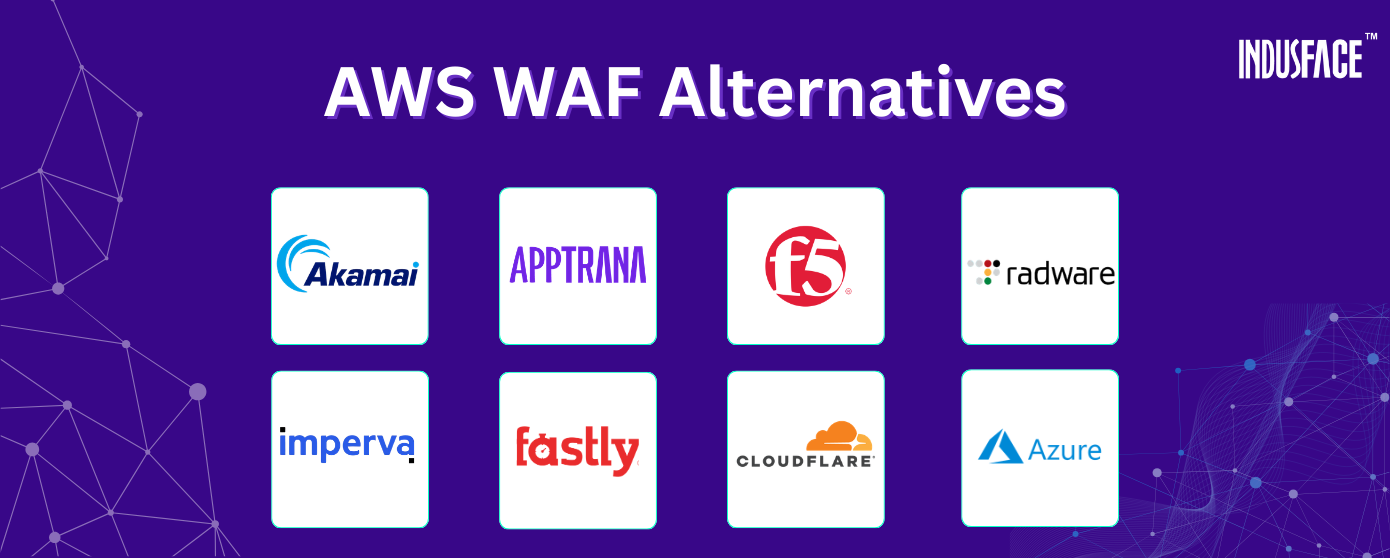
- AppTrana
- Cloudflare
- Imperva
- Akamai
- Fastly
- Radware
- Azure WAF
- F5
- Palo Alto
- Google Cloud Armor
- Barracuda
- Fortiweb
- ThreatX
- Sucuri
- ModSecurity(Open Source)
Top 5 AWS WAF Alternatives: A Quick Snapshot Comparison
| WAF Feature | AWS WAF | AppTrana | Cloudflare | Imperva | Akamai | Fastly |
| Gartner Peer Insights Rating | 4.4 | 4.9 | 4.5 | 4.7 | 4.7 | 4.9 |
| Gartner Peer Insights Customer Recommendation Rating | 90% | 100% | 93% | 92% | 88% | 97% |
| DDoS Monitoring | $3000 per month | Available | Enterprise Only | Add-On | Add-On | Ultimate Plan only |
| Virtual Patching | – | Starts at $99 | Self service | Add-On | Add-On | Ultimate Plan only |
| Autonomous Vulnerability Remediation | No | Yes | No | No | No | No |
| Payload Inspection Size | 64KB | 134MB | 128KB | Unknown | Starts: 8KB
Max: 128KB |
Unknown |
| Custom Port Support | Yes but needs advanced, self-service configuration | Fully managed custom port support | Limited | Yes | 80/443 Only | 80/443 Only |
| NTLM Support | No | Yes | No | Unknown | No | Unknown |
| Bot Protection | Basic | Yes | Yes | Not available in essentials
Add-on in Professional Bundled in Enterprise Plan |
Add-On | Yes, but unsure whether it is bundled in all plans |
| Response Timeout | Default: 30 seconds
Max: 300 seconds |
Default: 300 seconds
Max: 300 seconds |
Default: 120 seconds Enterprise: 6000 seconds |
Default: 360 seconds
Max: Unknown |
Default: 120 seconds
Max: 599 seconds |
Default: 60 seconds
Max: 300 Seconds |
| Managed Services /24*7 SOC | Only through SI partnerships | Available | Enterprise only | Add-On | Add-On | Ultimate Plan only |
| DAST Scanner | Not Available | Bundled in all plans | Not Available | Not Available | Not Available | Not Available |
| Malware Scanner | Not Available | Available | Available | Not Available | Available | Not Available |
| Asset Monitoring | Not Available | Bundled in all plans | Not Available | Not Available | Not Available | Not Available |
| Penetration Testing | Not Available | Available | Not Available | Not Available | Not Available | Not Available |
| API discovery | Not Available | Available | Available | Available as an Add-On | Available | Available |
| API Security | Basic capabilities through API Gateway | Available | Available | Available | Available | Available |
| API Scanning | Not Available | Available | Not Available | Not Available | Not Available | Not Available |
| API Pen Testing | Not Available | Available | Not Available | Not Available | Not Available | Not Available |
| Workflow-based bot mitigation | Only through SI partnerships | Available | Enterprise only | Add-On | Add-On | Ultimate Plan only |
| Origin Protection | Available | Bundled in all plans | Limited | Not Available | Add-On | Add-on |
| SwyftComply | Not Available | Available | Not Available | Not Available | Not Available | Not Available |
| Client-side Protection | Not Available | Available | Available | Available | Available | Not Available |
| DNSSEC | Available | Available | Available | Available | Available | Not Available |
| Custom Error Page | Available | Available | Available | Available | Available | Available |
The Top Five Alternatives to AWS WAF: In-Depth Comparison
1. AI powered AppTrana WAAP
AppTrana WAF offers rapid virtual patching of critical vulnerabilities, such as SQLi and XSS, within 24 hours, with a ZERO false positive guarantee, ensuring enhanced web application security.
Why Choose AppTrana WAF: Key Benefits
Bundled DAST Scanner and Pen Testing
False positives (blocking legitimate traffic) and false negatives (allowing harmful traffic) are common challenges WAFs face. To tackle these challenges effectively, users must opt for penetration testing providers or subscribe to automated vulnerability and open-source application security scanners.
AppTrana is distinguished as the only WAAP provider that provides both a DAST scanner and manual penetration testing as part of its offering.
The embedded DAST scanner can be easily configured to scan web and API applications daily or according to a preferred frequency. The accompanying dashboard offers insights into the number of open vulnerabilities protected by core rules and those requiring custom rules (virtual patches).
Additionally, the premium plan offers users the option for manual penetration testing, with the added benefit of one revalidation.
Autonomous Patching with SwyftComply
After scanning and pen-testing, a complete report of vulnerabilities is generated. Users can opt for SwyftComply to apply custom rules or virtual patches at the WAF level.
This autonomous remediation of vulnerabilities provides a clean, Zero-Vulnerability Report, ensuring swift compliance and simplifying patching complexities.
Fully Managed Service
AppTrana’s security research team provides comprehensive, 24×7, fully managed services covering DDoS monitoring, virtual patches, and false positive testing. They take complete responsibility for configuring and updating security policies and detecting, alerting, and mitigating attacks.
Critical vulnerabilities receive prompt attention within 24 hours, and the managed services team serves as an extended SOC team to validate false positives.
Request Inspection Size
AppTrana’s default configuration enables seamless request inspection for files of sizes up to 134MB, ensuring that no malicious attempts go unnoticed.
The response timeout in AppTrana is configured generously, granting a window of 5 minutes for responses to be processed without any interruptions.
Automated Positive Security Model for API
AppTrana WAAP offers a valuable feature by automating positive security models for APIs. The process involves API discovery, vulnerability scanning, penetration testing, and generating positive security policies within the platform.
Additionally, even teams lacking API documentation on Swagger and Postman can benefit, as the API discovery feature automatically downloads the Swagger file, and the managed services team assists with the Postman file creation for critical open APIs.
Protecting Against Client-Side Threats
With AppTrana WAAP, websites gain client-side protection from threats like Magecart, skimming, and form-jacking, as mentioned in the OWASP Top 10. Its continuous monitoring of third-party JavaScript ensures unauthorized modifications are detected and blocked. This enhances data security and supports adherence to PCI DSS v4.0 and other industry regulations requiring client-side security measures.
Limitations of AppTrana WAF
Legacy APIs
AppTrana WAAP, while robust in API security, does not extend support to legacy API formats like SOAP.
Threat Intelligence
AppTrana’s main approach to threat intelligence involves leveraging third-party feeds, and first party threat intelligence is not as robust as some of the larger competitors. That said, the third party feeds cover most bases.
See AI-powered AppTrana WAAP in action:
2. Cloudflare
Cloudflare WAF is a security feature offered by Cloudflare, a well-known content delivery network (CDN) and internet security company.
Its global network ensures fast and efficient blocking of malicious traffic, enhancing website and application security.
Benefits of Cloudflare WAF
Global Threat Intelligence
Cloudflare’s global network, handling over 2 trillion requests daily, offers an unparalleled advantage in delivering top-tier threat intelligence.
With such an extensive and diverse dataset, Cloudflare gains unique insights into emerging threats and attack patterns, enabling rapid identification and mitigation of security risks for its customers.
Free CDN
A significant perk of CloudFlare is its free CDN, which seamlessly integrates without altering image URLs or displaying cdn.domain.com. It consistently delivers dependable performance and yields optimal SEO results, with no negative impacts observed.
DDoS Mitigation
Cloudflare safeguards a staggering 7,591,745 active websites worldwide and is renowned for countering some of the most substantial DDoS attacks on record. Recently, Cloudflare successfully defended against the largest-ever volumetric DDoS campaign, featuring numerous waves of hyper-volumetric attacks, with peak rates exceeding 50-70 million requests per second (RPS), surpassing previous benchmarks.
Like AppTrana, Cloudflare implements an adaptive DDoS mitigation system, continuously adjusting to user behaviour and optimizing rate limits accordingly.
This proactive approach enhances Cloudflare’s defensive capabilities against DDoS attacks while ensuring optimal performance and a seamless user experience.
Look at our blog post on Cloudflare WAF Vs. AWS WAF, where you can discover each solution’s distinctive features, advantages, and constraints.
Challenges with Cloudflare WAF
False Positive Management
Writing generic rules for the extensive network of hundreds and thousands of applications poses a challenge for Cloudflare, resulting in false positives.
Managing false positives can be challenging for those with security as a part-time responsibility or without a sizable security team. In such cases, application owners might have to place the WAF in log-only mode or loosen its restrictions, which can render the WAF less effective.
Additionally, some users have reported latency issues due to server location differences between customers’ original servers across various regions.
DDoS Monitoring
Despite Cloudflare’s excellent DDoS mitigation stack, users on free and pro plans lack support during an attack, with chat support limited to the business plan.
Expert guidance becomes essential during sophisticated DDoS attacks, and access to enhanced support options is restricted to the enterprise plan.
Virtual Patching
Virtual patching proves indispensable in web application security, offering prompt remediation to fix vulnerabilities.
The initial step involves thoroughly discovering and inventorying all web applications, accurately identifying critical vulnerabilities, and eliminating false positives. Virtual patches can then be deployed to safeguard against targeted attacks. However, you can get this only with Cloudflare’s enterprise plan or you’ll have to write rules on your own.
Alternatively, organizations may opt to manage their rules internally. Unfortunately, this path often leads to a challenge—many individuals lack the necessary skill set to write accurately and extensively test rules, particularly when addressing false positives.
In such a case, you can check out the Cloudflare WAF alternatives.
3. Imperva
With a prominent position in the Gartner Magic Quadrant for Web Application Firewalls, Imperva is a trusted provider of WAF solutions. Imperva claims that 90% of WAAP deployments are configured in block mode.
Their comprehensive offerings include Cloud WAF and an on-premises or virtual appliance WAF Gateway, ensuring robust security against OWASP Top 10 threats.
Imperva’s unique inclusion of Runtime Application Self-Protection (RASP) capabilities sets it apart, making it one of the few WAAP providers to offer this cutting-edge feature.
Important features of Imperva WAF
Zero False Positive
Dealing with false positives and false negatives is a common challenge leading to resource wastage and excessive noise.
Imperva’s near-zero false positive guarantee drives over 90% of its customers to deploy their WAF in blocking mode.
Inbuilt RASP
Imperva RASP (Runtime Application Self-Protection) further minimizes the false positives by consolidating network, application, and database security intelligence into a cohesive report.
This enables decisive actions based on real risk, easing the proactive blocking of malicious IP addresses.
Hybrid Deployment
Providing specialized support for modern multi-cloud, DBaaS, and hybrid database scenarios, Imperva’s data-centric security platform is designed to simplify data security and compliance for organizations of all kinds.
It caters to organizations focusing on securing customer data in the cloud and safeguarding critical internal records stored in on-premise servers.
Latency
Speed is of utmost importance in countering DDoS attacks, as users demand seamless website performance and rapid loading times.
Imperva takes a proactive approach by deploying Super PoPs within strategic Internet connectivity hotspots, enabling rapid, on-demand DDoS mitigation with minimal latency.
Challenges with Imperva WAF
Optional Managed Service
Imperva’s enterprise services offer continuous assistance from security experts, but it’s worth noting that it is an add-on service for all plans.
API Discovery as an add-on
The foundation of robust API security lies in API discovery enabling organizations to build an accurate and detailed inventory of their APIs. Imperva’s API discovery remains an add-on service.
AppTrana’s license goes beyond standard API security by providing automated API discovery and the added benefit of API penetration testing, a service that none of the WAAP providers currently offer.
4. Akamai
As one of the first-ever WAF products introduced, Akamai aims to defend against attacks, prevent website overload, mitigate harmful bots, and secure APIs.
Akamai App & API Protector brings together a suite of security features, including application security, bot protection, API security, and DDoS protection.
Leveraging Akamai’s extensive CDN infrastructure, the WAF efficiently filters and monitors incoming HTTP/HTTPS traffic, identifying and blocking malicious activities in real-time.
Akamai WAF: The Positives You Should Know
Adaptive Threat Detection
Akamai WAF’s strength lies in the Adaptive Security Engine, a sophisticated technology incorporating machine learning, real-time security intelligence, advanced automation, and insights from a vast team of 400 threat researchers.
With the Adaptive Security Engine, manual tuning has become a thing of the past as it introduces zero-touch updates, providing a nearly hands-off experience. This advanced feature improves detections by 2x and reduces false positives by 5x.
Prolexic
Prolexic, Akamai’s DDoS protection service, benefits from a 20 Tbps network to effectively shield against DDoS attacks. Equipped with high-capacity scrubbing centers spread across 32 metro locations worldwide, Prolexic efficiently handles traffic by directing it to the nearest available scrubbing center.
The inclusion of a Security Operations Command Center (SOCC) ensures round-the-clock support for this fully managed DDoS protection solution. The SOCC leverages proactive and custom mitigation controls to halt attacks instantly, guaranteeing fast and precise DDoS defenses.
Page Integrity Manager
As almost half of a typical website’s content originates from third parties, attackers exploit this channel to implant malware and steal users’ sensitive information, such as credit card details.
By providing advanced visibility and intelligence, Page Integrity Manager equips organizations with the tools to tackle this escalating threat effectively, garnering positive feedback from early adopters.
Limitations of Akamai WAF
False Positives
Dealing with false positives on Akamai can be as challenging as with AWS WAF, especially when organizations do not have certified in-house security engineers or have not subscribed to the add-on managed services.
Payload Inspection Size
The payload inspection capability of Akamai has a limitation of 128KB, with the initial setup restricted to examining only 8KB of data. Organizations seeking to handle larger payloads must customize their configuration accordingly.
Managed Service
While Akamai offers a comprehensive service, it is more expensive than most other WAAP providers in the premium market.
If you have the budget, Akamai’s service delivers exceptional effectiveness, especially with managed services.
A premium version is also available, catering to customers who desire personalized support and prioritized escalation paths.
5. Fastly
Fastly claims that 90+% WAAP deployments are in block mode.
False positive forces the decision between blocking mode or staying in log-only mode forever. Fastly’s proprietary detection technology, SmartParse, is the key factor that drives their decisions.
While AppTrana features a 100% block mode deployment, Fastly and Imperva are the only companies featuring this figure on their websites.
Here are the most common benefits of Fastly
SmartParse
The main goal of SmartParse is to make rapid decisions when assessing requests and identifying potential malicious payloads through context and execution analysis.
As a result, scaling protection becomes a breeze, sparing you from the usual maintenance hassles in other WAFs.
Network Learning Exchange (NLX)
Fastly’s differentiating factor lies in the Network Learning Exchange (NLX), a trusted IP reputation feed sourced from validated malicious activity data collected from Signal Sciences customers.
NLX can detect attack patterns across the customer network, empowering proactive alerts to identify potential threats before they turn malicious on websites.
Flexible Deployment
Fastly, like Imperva, provides versatile deployment options, ensuring the protection of applications and APIs in different scenarios such as containers, on-premises, the cloud, or the edge, all streamlined into one integrated solution.
Challenges with Fastly WAF
Managed Service
If you require a managed WAF with virtual patches, DDoS monitoring, latency monitoring, and custom workflow-based bot rules, you will need to choose the ultimate plan, as these services are not offered in the starter and advantage plans.
Support
You will need to subscribe to the ultimate plan for phone and chat support, as they are not available in any other subscription levels. Additionally, 24/7/365 support for general inquiries is limited to business hours in San Francisco, London, or Tokyo.
Rate limiting
This limitation could be a dealbreaker for any high-profile or large-scale resource.
Only the Premier platform and selected package offerings come with advanced rate limiting, indispensable for safeguarding against excessive traffic and misuse. This feature is not available in the Professional or Essential platforms.
If you are looking for budget-friendly DDoS protection and API security options, Fastly may not meet your requirements as an alternative to AWS WAF.
Verdict
Considering the various alternatives to AWS WAF, AppTrana’s fully managed service, Akamai and Imperva’s competitive options, and Fastly’s deployment flexibility and proactive detection stand out.
If you are looking for complete WAAP protection to protect from advanced threats within a tight budget, AppTrana is a strong contender.
Starting a trial is the primary step in understanding how these AWS WAF alternatives function with your application.
While we cover the top 5 alternatives to AWS WAF here, don’t miss our blog comparing The Best WAAP providers in the market.
Stay tuned for more relevant and interesting security articles. Follow Indusface on Facebook, Twitter, and LinkedIn.

Frequently Asked Questions (FAQs)
No. Most teams keep AWS for hosting and swap the edge and security operating model. You can keep your origins on AWS and place a cloud-agnostic WAAP/WAF in front, or choose a managed WAAP provider that runs the protection outcomes while your apps stay on AWS.
It is usually not “feature gaps.” It is operational ownership. AWS WAF gives you a strong rules engine, but sustained outcomes require ongoing tuning, monitoring, and incident execution. Teams switch when they do not want WAF operations to be a permanent internal program.
Managed rule groups reduce the effort of writing detections from scratch, but they do not eliminate tuning. False positives still require testing on real traffic, adding exceptions, validating business logic flows, and monitoring drift as apps change. Teams switch when they want a provider to own that lifecycle and keep block mode stable without breaking production.
If your APIs rely on larger JSON payloads, body inspection limits can create coverage gaps because only the inspectable portion is evaluated. Teams switch when they do not want to manage oversize behavior, payload workarounds, and regression testing across multiple AWS integration points, especially as the API estate grows.
Because the trigger is often the incident experience, not the existence of protection. During a live attack, teams want 24×7 monitoring, guided mitigation, and predictable escalation and post-incident hardening. If those workflows are not owned end-to-end, the customer team still carries the operational burden.
Because cost can scale with multiple levers at once: number of web ACLs, number of rules and rule groups, total requests processed, and additional charges tied to higher capacity usage and deeper inspection. Teams switch when they want fewer moving parts and a clearer “outcome-owned” cost model.
Not usually. Marketplace rule groups can improve detections for specific threat types, but you still own deployment decisions, tuning, testing, exception handling, and incident workflows. If your core pain is operational overhead, buying more rule groups rarely fixes it.
It increases coordination overhead. AWS WAF can protect different entry points such as Amazon CloudFront, Elastic Load Balancing, and Amazon API Gateway, but consistent policy, visibility, and change control across many apps becomes a process problem. Teams switch when they want consolidated policy management, monitoring, and reporting across web and APIs without stitching together multiple pipelines.