Oracle E-Business Suite (EBS) sits at the center of finance, procurement, and payment operations for many large enterprises. When a critical vulnerability surfaces in a module like Oracle Payments, the impact reaches well past IT. It touches financial data, transaction integrity, and regulatory exposure.
CVE-2026-46817 is exactly that kind of vulnerability, and it is now being actively exploited. Shadowserver currently tracks around 950 Oracle EBS instances exposed to the public internet, with no visibility into how many remain unpatched against this vulnerability.
What Is CVE-2026-46817?
The vulnerability lives in the File Transmission component of Oracle Payments, part of Oracle E-Business Suite versions 12.2.3 through 12.2.15. Oracle traces the root cause to three weaknesses working together: improper privilege management, improper authentication, and missing authentication for a critical function.
The combination lets an attacker send a crafted HTTP POST request to the Oracle Payments File Transmission interface without any credentials and without prior access to the targeted environment. Oracle rates the vulnerability 9.8 out of 10 on the CVSS v3.1 scale and classifies it as low complexity to exploit.
Oracle shipped the fix in its May 2026 Critical Patch Update, part of a release that addressed 35 vulnerabilities across its product line, 11 of them critical.
CVE-2026-46817: Exploitation Timeline
Patch availability did not buy organizations much runway. Threat intelligence firm Defused reported the first exploitation attempts against Oracle EBS honeypots over the weekend of June 27 to 28, 2026, several weeks after Oracle released the patch.
What makes this notable is that no public proof-of-concept existed at the time. Researchers believe that the exploit may have been developed through patch diffing, where attackers compare patched and unpatched versions to reconstruct a working exploit. This pattern — where a vendor patch doubles as a roadmap for attackers — is increasingly common with enterprise ERP software, and it shrinks the window between patch release and active attack.
Researchers describe the observed activity as a single source running a targeted, proof-of-concept style file-read attack against honeypot infrastructure, not broad internet-wide scanning. Targeted activity from one actor rarely stays isolated once an exploit path is confirmed to work.
Shadowserver’s telemetry also shows that a significant number of these exposed Oracle EBS instances are located in the United States and Europe. How many of those remain unpatched is not public information.
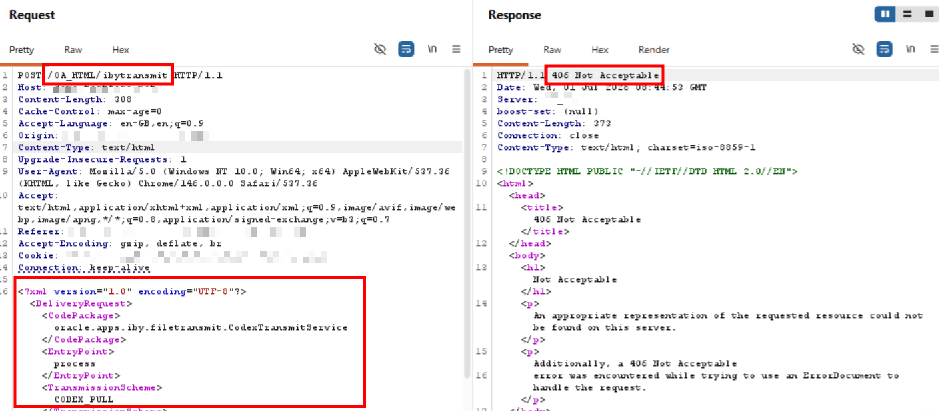
Exploitation targets the /OA_HTML/ibytransmit endpoint through crafted POST requests carrying XML payloads. Because no authentication is required, the attacker does not need valid credentials, an existing session, or a foothold anywhere else in the environment. Network access to the EBS HTTP interface is enough.
What Is at Stake
Oracle Payments handles the financial plumbing behind enterprise transaction workflows: payment processing, financial data exchange, and settlement operations. A successful compromise through this vulnerability can expose sensitive files including database credentials, encryption keys, and payment processor API keys.
Access to any of these can cascade. Attackers who retrieve database credentials or API keys can authenticate backend services, manipulate payment workflows, or move laterally into systems connected to EBS. Given the module’s role, a compromise also risks customer payment data exposure, transaction disruption, and regulatory fallout for the affected organization.
Indicators To Check For
Security teams should review web server and application logs for:
- Unusual POST requests to
/OA_HTML/ibytransmit, particularly ones carrying XML payloads - Requests attempting to reach system files, credential stores, or payment-related configuration files through the File Transmission component
- Any EBS instance that was internet-facing and unpatched after May 28, 2026, which should be treated as potentially compromised pending investigation
Because the observed attacks specifically targeted internet-facing deployments, externally accessible EBS instances deserve first priority during any investigation.
Mitigation Guidance for CVE-2026-46817
Apply the May 2026 Critical Patch Update immediately
Organizations running Oracle Payments versions 12.2.3 through 12.2.15 should apply Oracle’s May 2026 Critical Patch Update immediately. Researchers have already reported exploitation attempts targeting vulnerable systems, making timely remediation essential.
Restrict internet access to EBS web interfaces
Until patching is complete, Oracle E-Business Suite web interfaces should be restricted to trusted internal networks wherever possible. Systems that do not require direct internet access should not be publicly exposed.
Conduct a compromise assessment after patching
After applying the security update, organizations should conduct a compromise assessment to determine whether exploitation occurred before remediation. This review should include web server logs, requests targeting the /OA_HTML/ibytransmit endpoint, application configuration files, database credentials, encryption keys, payment processor API keys, and other sensitive assets that may have been accessed during an attack.
Rotate all sensitive credentials if compromise is suspected
If compromise is suspected, administrators should perform a full forensic investigation and rotate database credentials, encryption keys, API keys, and other sensitive credentials stored on the affected host.
Audit all internet-facing Oracle EBS deployments
Beyond this vulnerability, this is a good moment to audit all internet-facing Oracle E-Business Suite deployments more broadly and confirm none were exposed by oversight rather than necessity.
How AppTrana Helps Close the Gap
AppTrana provides default protection against observed exploit attempts targeting CVE-2026-46817 out of the box. When a crafted POST request hits the /OA_HTML/ibytransmit endpoint carrying a crafted XML payload targeting the File Transmission component, AppTrana rejects it before it reaches the origin server, returning a 406 Not Acceptable response. This protection is live from day zero for onboarded applications, with no rule tuning or manual configuration required on the customer’s part.
Here is what that blocked exploit attempt looks like in practice: a crafted request to the vulnerable endpoint met with a 406 Not Acceptable response instead of a compromise.
Stay tuned for more relevant and interesting security articles. Follow Indusface on Facebook, Twitter, and LinkedIn.