In this article, we break down the similarities, differences, strengths, and limitations of Akamai App & API Protector and Cloudflare WAF to help you choose the right fit.
Quick Summary
Akamai is the stronger fit for large enterprises that need its edge scale, want a global security team behind them, and can absorb the cost of getting there. Cloudflare suits mid-market teams that want CDN, DNS, and WAAP bundled under one vendor and prefer to configure and tune rules themselves.
On both platforms, that operational layer, rule tuning, false positive resolution, incident response, comes as a separate paid tier. AppTrana delivers it differently: autonomous protection with expert-backed tuning and unlimited virtual patching, with no add-on tier required.
How this comparison is grounded (our experience)
This comparison is based on experience from teams evaluating and migrating between Akamai App & API protector and Cloudflare WAF, including:
- Migration insights we see repeatedly: We have supported hundreds of web apps and APIs moving from Akamai and Cloudflare to AppTrana. The operational challenges highlighted below reflect consistent pain points such as false positives, time to enforcement, incident response effort, and ongoing tuning overhead.
- Public vendor documentation: Feature capabilities, limits, and pricing references are sourced from publicly available Akamai and Cloudflare documentation.
- Practical validation steps: For each real-world insight, we include simple ways you can validate it in your own environment (what to check in logs, what to measure, and what to ask vendors).
What is Akamai App & API Protector?
Akamai App & API Protector is Akamai’s edge-based WAAP product, combining a web application firewall, API protection, DDoS mitigation, and client-side attack detection (Page Integrity Manager) on Akamai’s global network. Bot Manager and managed security services are separate add-ons. It is built for large, high-traffic enterprises that can tune it themselves or pay for Akamai’s managed tier.
What is Cloudflare WAF?
Cloudflare’s Web Application Firewall (WAF) is a robust security feature that shields websites and web applications from cyber threats. Acting as a barrier between your web servers and potential attackers, it thoroughly analyzes incoming web traffic, effectively filtering out malicious requests and preventing potential attacks.
Cloudflare WAF enhances security and accelerates the performance of countless websites, APIs, SaaS services, and various online assets, ensuring a safer and faster online experience.
Akamai vs Cloudflare WAF (2026): Strengths, Trade-Offs, and Best-Fit Use Cases
Choosing between Akamai and Cloudflare WAF comes down to operational model: who owns tuning, what incident response looks like, and what advanced protections cost once you move beyond baseline coverage.
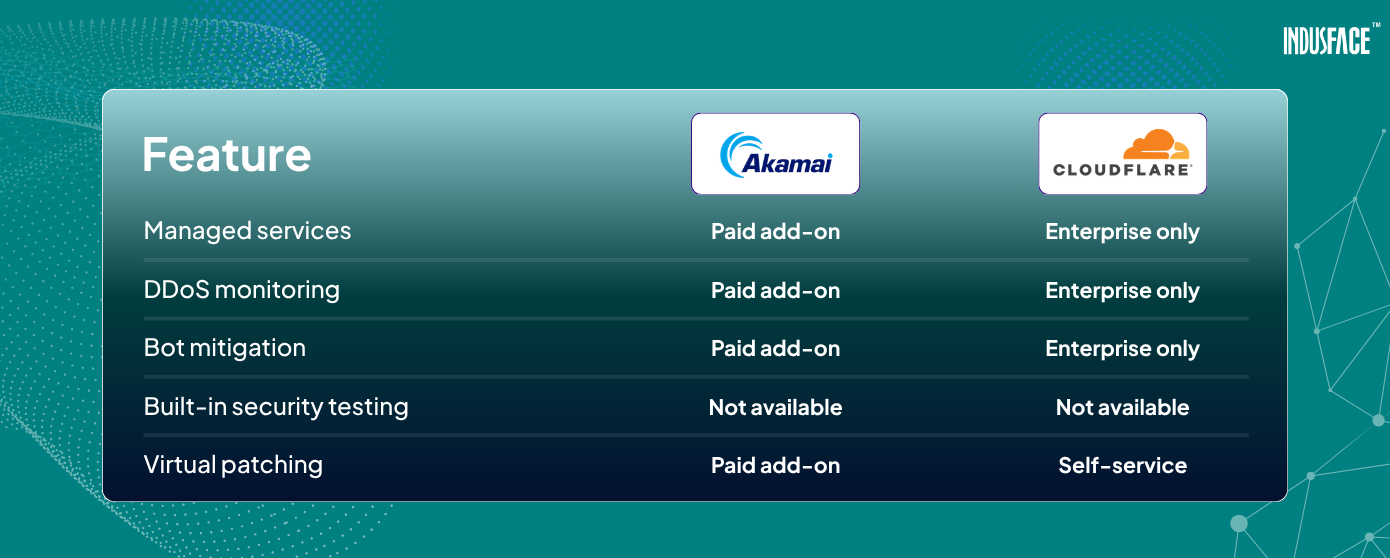
DDoS Mitigation
Both Cloudflare WAF and Akamai deliver highly capable, large-scale DDoS mitigation backed by massive global infrastructure. Each has a proven history of absorbing extremely large attacks, making raw traffic capacity rarely the limiting factor for either platform.
From a capability standpoint, both platforms are very strong.
Where practical differences emerge is in cost structure, adaptive protection, and operational experience.
Cloudflare includes baseline DDoS protection across its Free, Pro, and Business plans. On Cloudflare WAF Enterprise, that DDoS absorption is unmetered as standard. However, behavioral Layer 7 protection and active response, the pieces that matter most against sophisticated, adaptive attack patterns, are paid add-ons on top of that base coverage.
Akamai’s DDoS protection is delivered through Prolexic as a separate add-on contract, positioned as an enterprise-grade offering with higher costs and deeper operational involvement. Billing is metered, and that meter includes attack volume itself, so a sustained campaign can drive costs up at the exact moment you’re under attack.
From migrations: DDoS capacity is rarely the challenge. DDoS operations are.
What we see:
Both Cloudflare and Akamai platforms provide robust high-volume defense; however, operational gaps, such as delayed tuning and unclear escalation workflows, can hinder real-time response effectiveness.
Why it happens:
Infrastructure absorbs traffic, but effective DDoS defense requires rapid behavioral tuning, response orchestration, and post-incident hardening.
How to validate:
Ask each vendor: “Show a live DDoS incident workflow end-to-end: detection, tuning changes, verification, and post-incident improvements.”
API Security
Both Cloudflare and Akamai provide API security beyond traditional WAF controls, including endpoint discovery, traffic inspection, and anomaly detection.
Cloudflare integrates API discovery and protection into its unified platform. On Cloudflare WAF Enterprise, that coverage is signature-based API protection included in the base plan; schema-aware validation, customized rate-limiting, and other behavior-based protections against sophisticated abuse are separate add-ons requiring additional tuning.
Explore the practical gaps teams encounter with Cloudflare’s API protections.
Akamai delivers inline, signature-based API protection as part of App & API Protector. Deeper, enterprise-wide API security, covering API discovery, positive security model, and behavioral analysis, is a separately licensed product with its own deployment, not part of App & API Protector itself.
From migrations: API risk is driven by unknown endpoints and authentication abuse.
What we see:
Teams routinely uncover undocumented APIs and unexpected traffic patterns, especially around mobile apps, partner integrations, and legacy services.
Why it happens:
API environments evolve faster than documentation and governance.
How to validate:
Ask vendors: “How do you continuously discover shadow APIs and detect abuse that uses valid authentication and business logic?”
Bot Management
Both Cloudflare and Akamai offer bot protection, but neither bundles full behavioral detection by default. On Cloudflare WAF Enterprise, signature-based bot detection is included in the base plan, but full behavioral Bot Management, the tier needed for credential stuffing, scraping, and account takeover patterns, is a paid add-on. Business plan users get Bot Fight Mode, a simpler ruleset with limited behavioral detection. Once behavioral Bot Management is turned on, it counts against the same request limit as your WAF and API traffic, so you can hit that limit and see higher bills sooner than expected.
Akamai Bot Manager is a standalone add-on, separate from App & API Protector. Customers need to license it separately. Two tiers exist: Bot Manager Standard (signature-based) and Bot Manager Premier (behavioral, with SDK-based device fingerprinting). The add-on stacking adds both cost and operational surface.
AI and LLM Protection
Both Akamai and Cloudflare launched AI-specific firewall products in 2025. Akamai Firewall for AI protects AI inference endpoints and LLM-backed applications from prompt injection, data exfiltration, and model abuse, integrated with App & API Protector for enterprise teams deploying AI agents and copilots.
Cloudflare AI Gateway provides observability, rate limiting, and caching for LLM API calls, paired with a Firewall for AI product that inspects prompts and responses for policy violations.
Both platforms are early in this category, built as extensions of existing WAAP infrastructure rather than ground-up AI security products.
AppTrana AI Shield is purpose-built for this layer, covering the OWASP LLM Top 10 including prompt injection, jailbreaking, model abuse, and denial-of-wallet (token-bill abuse), built into the same platform that protects web apps and APIs. AppTrana also applies AI on the other side of this problem: SwyftComply AI runs AI-driven penetration testing across web apps, APIs, and AI-powered endpoints. Findings are autonomously remediated at the edge and verified by security experts, closing the gap between discovering a vulnerability and actually being protected against it.
Where Cloudflare Tends to Fit Better
Comprehensive Bundle for SaaS Start-ups
Cloudflare offers a broad bundled platform that includes SSL management, vanity domains, and built-in DDoS, WAF, bot, and API protection, making it an attractive option for SaaS start-ups and fast-growing teams.
Akamai delivers many comparable capabilities, including bot management and API security, but most advanced features are typically tied to higher-cost enterprise packages and managed services.
In practice, Cloudflare’s tiered pricing is generally more accessible for start-ups and mid-market teams, while Akamai’s premium model aligns more naturally with large enterprise environments.
User-Friendly Feature Adoption
Cloudflare’s broader ecosystem, including CDN, DNS, rate limiting, mini-rulesets, and analytics, is easier for many teams to manage from a single control plane. This simplifies deployment and administration, particularly when security responsibilities are shared across DevOps teams rather than owned by a dedicated security function.
If you are evaluating Cloudflare beyond surface-level capabilities, see our detailed comparison of AppTrana vs Cloudflare, covering false positives, bot mitigation, and operational overhead in real deployments.
Where Akamai Tends to Fit Better
Client-Side Attack Protection (Page Integrity)
The most effective strategy for countering in-browser attacks is detecting suspicious and malicious script actions. Page Integrity Manager from Akamai achieves this by observing user sessions and monitoring real-time scripts.
Akamai’s Page Integrity Manager offers an edge in detecting in-browser attacks, such as web skimming and Magecart.
Managed Service
Akamai’s Managed Security Service is tailored to your business requirements and provides an all-encompassing solution. It offers a comprehensive suite of services backed by Akamai’s industry expertise and best practices. Their offerings include:
- 24/7 Monitoring and Anomaly Detection
- Rapid response to identified threats
- Round-the-clock access to a Security Operations and Coordination Center (SOCC) for attack support
- Guaranteed response time of 30 minutes or less, based on the severity of the issue.
- In-depth, detailed postmortem report provided by security experts
Although it carries a premium cost for both the product and the managed services, the managed service consistently receives top ratings. It proves to be highly effective if you have the budget for Akamai, especially with their managed services.
Global Intelligence
Akamai boasts a dedicated team of over 400 security researchers tirelessly updating security configurations and policies. These experts collaborate with machine learning models and real-time threat intelligence feeds to keep the Adaptive Security Engine updated. As a result, Akamai claims a 4X reduction in false positives.
While Cloudflare is renowned for its top-tier threat intelligence, it faces the challenge of creating generic rules for its vast network of hundreds and thousands of applications, leading to the chance of false positives.
If you are evaluating Akamai, see our detailed comparison of AppTrana vs Akamai App & API Protector, covering support costs, billing during attacks, and API security contracts.
Managed WAAP: The Outcome-Based Alternative to Premium Managed WAF Add-Ons
Akamai and Cloudflare both offer managed security support, but it is typically available only through premium tiers and add-on services. Akamai delivers managed protection around platforms like Kona Site Defender and Prolexic, while Cloudflare ties deeper operational support to its Enterprise plans. In most standard deployments, teams still own rule tuning, false positive handling, and day-to-day incident response.
Managed WAAP, on the other hand, is an outcome-based service model. The provider takes responsibility for the protection lifecycle from enforcement readiness to live response with defined workflows and clear response timelines.
In practice, a managed WAAP model typically includes:
- Moving to stable block mode without breaking critical flows
- Continuous false positive monitoring and remediation under SLA
- 24×7 detection and response for DDoS, bot abuse, and emerging attack patterns
- Post-incident analysis and preventive updates
- Application-specific protections (like virtual patching) when code fixes lag
- Regular reporting and reviews so protections don’t drift over time
Why Premium Managed Add-Ons Fall Short in Practice
Even when teams upgrade to Cloudflare’s Business plan or Akamai’s managed services, there are operational gaps that remain:
- Support vs. Operations: Premium plans may offer priority support or SLAs, but they don’t fully own the security operations, your team still configures, tunes, and responds.
- Cost Barriers: Cloudflare’s Business/Enterprise tiers and Akamai’s professional services can be expensive and are billed in hours spent by the vendors’ security engineers. This restricts access to managed support for many organizations that are cost sensitive.
- Manual Tuning Continues: Even with higher support tiers, false positives, rule maintenance, and incident investigation still fall largely on internal teams.
For teams without dedicated AppSec or DevSecOps capacity, this creates friction: upgrades bring more features, but not less operational effort.
When Premium Managed Services Are Still the Right Fit
Premium managed services from Akamai or Cloudflare can be suitable if your organization:
- Can budget for higher-tier plans with dedicated support
- Has internal expertise to complement external help
- Values platform control and customization over a fully outsourced model
In that setup, the managed add-on becomes a supplement to internal operations.
Migration snapshot 1: D2CAn e-commerce brand transitioning from a bundled Cloudflare WAF setup
- Previousstate: The business relied on a Cloudflare WAF add-on bundled with Salesforce. Handling new attack types required frequent manual rule creation, while false positives and latency issues were common.
- Reason for change: The team needed quicker threat mitigation and lower operational effort, beyond simply adding more security features.
- Key challenges during transition: Maintaining strong protection without compromising site speed or increasing tuning workload.
- After migration: Built-in managed protection with custom rules, continuous monitoring, real-time mitigation for DDoS, bot, and zero-day attack patterns, and virtual patching of critical risks within 72 hours.
- Measured results: Improved uptime, faster site performance, significantly fewer false positives, and no critical vulnerabilities left unresolved.
Migration snapshot 2: Regulated brokerage firm migrating from Akamai WAF
- Previousstate: The brokerage relied on Akamai WAF to secure high-volume trading platforms and customer portals. Policy management was complex, tuning cycles were slow, and responding to new vulnerabilities required significant manual effort across environments.
- Reason for change:The organization needed support for custom ports, faster risk remediation, stronger compliance alignment, and reduced operational overhead while maintaining performance during peak trading activity.
- Key challenges during transition:Ensuring continuous protection without disrupting live trading flows, minimizing false positives, and meeting strict SEBI compliance and vulnerability remediation timelines.
- After migration:Built-in managed protection with custom rules, 24×7 monitoring, real-time mitigation for advanced threats, autonomous vulnerability remediation, and continuous audit-ready compliance posture.
- Measured results: Zero critical vulnerabilities left open during audits, faster remediation cycles, improved security visibility, and stable performance even during traffic spikes.
How to Validate Akamai and Cloudflare in Your Environments
Feature lists rarely reflect how a WAAP platform performs in production. Before signing or renewing with either vendor, get concrete answers to these:
- How long does it actually take to go live in block mode without breaking production traffic, and who is responsible for getting you there?
- When a false positive shows up after go-live, whose job is it to fix it, and is there a time commitment attached, or just a promise to “look into it”?
- Walk through what happens during a live attack: who makes the tuning change, how is it tested, and how long does it take to go live?
- Once an attack is over, does the platform learn from it automatically, or does someone need to manually update rules to stop it from happening again?
- New APIs get built constantly. How does the platform find the ones your team never told it about?
- Can it tell the difference between a real customer and an attacker who is using valid logins and normal-looking requests?
- Is vulnerability scanning and patching part of the same contract, or a separate line item with its own SLA (or lack of one)?
- Does the number you are quoted today cover everything, licensing, support, scanning, remediation, or will next year’s renewal look different?
- If audit season means someone on your team manually pulling together evidence, ask whether that is really necessary, or just how it is always been done.
If more than one of these needs a follow-up call, a change order, or extra budget to get a straight answer, that is worth knowing before you sign.
Why Teams Move to AppTrana
Here is how AppTrana handles the operational gaps that teams consistently flag when moving off Akamai and Cloudflare:
AI Pentesting to Autonomous Protection, Verified by Experts
On Akamai, patching your app’s specific vulnerabilities is a professional services request with no SLA attached. On Cloudflare, virtual patching is self-service, your team writes and applies the patch. On AppTrana, a vulnerability found by the built-in scanner, a third-party tool, or an AI-driven pen test gets patched automatically, and comes back as an expert-verified remediation report within a defined SLA.
Behavioral DDoS and Bot Protection Without Continuous Tuning Debt
AppTrana WAAP replaces static rate limits with AI-driven behavioral models that continuously analyze traffic across IP addresses, URIs, geographies, and usage patterns. The platform automatically recommends adaptive alert and block levels that evolve as application traffic grows and attack behavior changes.
This approach allows DDoS and bot threats to be mitigated in real time while preserving legitimate user experience. Protections adjust dynamically to seasonal traffic spikes, new abuse patterns, and business growth without requiring constant rule updates or operational intervention.
As a result, teams achieve consistent enforcement, reduced false positives, and effective attack mitigation without ongoing tuning effort or premium service dependencies.
In addition, AppTrana includes unmetered DDoS protection in all its plans without extra charges. Meanwhile, both Akamai and Cloudflare offer unmetered DDoS protection as an add-on. Cloudflare’s approach involves an add-on that bills users for every 10,000 requests.
API Discovery That Goes Beyond What is Documented
Most platforms protect what is registered. AppTrana continuously surfaces shadow APIs, “zombie” endpoints nobody’s touched in months, and AI/LLM infrastructure your team may not have flagged as in scope, automatically, without a manual audit.
One of its notable advantages is its accessibility to teams lacking API documentation in Swagger and Postman. Through the API discovery feature, obtaining the Swagger file is effortlessly automated. Furthermore, the managed services team plays a pivotal role in assisting with the creation of Postman files for critical open APIs.
24×7 Security Team
AppTrana’s security team continuously monitors your environment, fine-tunes policies, and resolves false positives before they ever reach you. Akamai requires a separate managed services contract for this kind of ongoing ownership. Cloudflare leaves tuning, false positive resolution, and incident response with your own team by default.
Managed CDN, Included
Neither Akamai nor Cloudflare bundles CDN performance into their core security contract. AppTrana includes a fully managed CDN with integrated analytics as part of the plan, so performance and protection aren’t billed or managed separately.
Regular Technical Security Reviews
Beyond day-to-day tuning, AppTrana includes scheduled technical security reviews as part of the plan, a periodic check-in on posture rather than something that only happens after an incident.
Payload Inspection Without a Blind Spot
Cloudflare inspects request bodies up to 128 KB by default. Akamai’s documented limits are lower still. AppTrana inspects payloads up to 100 MB and beyond, without a latency penalty, so large API bodies and file uploads don’t pass through uninspected.
Pricing That Doesn’t Move Against You
AppTrana includes unlimited request inspection, DDoS mitigation, and bot mitigation, with no caps on vulnerability assessments, virtual patching, or evidence collection. Usage allowance, professional services, and multi-year pricing are built into the subscription from the start. On Akamai, multi-year pricing and escalation terms are set per contract and vary by agreement. On Cloudflare, requests are metered across WAF, bot, and API traffic combined, so overages are a matter of when, not if.
Unified Application Security Platform
Asset discovery, managed WAF, vulnerability assessment, virtual patching, bot mitigation, DDoS protection, API security, AI Shield, and CDN all run on one platform. Akamai spreads these across separate products, Bot Manager, Prolexic, API Security, and Managed Security Service, each its own contract and pricing. Cloudflare spreads them across its own set of tiers and add-ons, each with its own pricing lever.
Akamai vs Cloudflare vs AppTrana: Choosing the Right WAAP for Your Needs
The right choice depends on your infrastructure, security maturity, and how much operational responsibility your team can carry after go-live.
Akamai App & API Protector is usually a better fit if you:
- Run large, high-traffic enterprise environments
- Need advanced edge-scale protection and client-side security
- Can budget for premium managed services or professional support
- Have security engineers to handle tuning and ongoing operations
Cloudflare WAF is usually a better fit if you:
- Want fast deployment with bundled CDN and security services
- Operate across multi-cloud or distributed origins
- Prefer tiered pricing with accessible entry points
- Can manage policy tuning and rule updates internally
AppTrana is usually a better fit if you:
- Want security operations owned by the provider
- Need predictable progress to block mode with minimal false positives
- Rely on continuous protection without building an internal SOC
- Want vulnerability remediation tied directly to live enforcement
Under active attack? Activate live mitigation
Feature Comparison: Akamai vs Cloudflare vs AppTrana
Here is a detailed feature comparison table for Cloudflare, Akamai and AppTrana:
| WAF Feature | Cloudflare | Akamai | AppTrana |
| Gartner Peer Insights Customer Recommendation Rating | 93% | 99% | 100% |
| Autonomous Vulnerability Remediation | Not Available | Not Available | Available |
| DDoS Monitoring | Enterprise Only | Add-On | Available |
| Virtual Patching | Self service | Add-On | Included, unlimited |
| Payload Inspection Size | 128KB | Starts: 8KB
Max: 128KB |
100+ MB |
| NTLM Support | No | No | Yes |
| Bot Protection | Yes | Add-On | Yes |
| Response Timeout | Default: 120 seconds Enterprise: 6000 seconds |
Default: 120 seconds
Max: 599 seconds |
Default: 300 seconds
Max: 300 seconds |
| Managed Services | Enterprise only | Add-On | Expert backed operations |
| DAST Scanner | Not Available | Not Available | Bundled in all plans |
| Malware Scanner | Available | Available | Available |
| Asset Discovery | Not Available | Not Available | Bundled in all plans |
| Penetration Testing | Not Available | Not Available | Available |
| API discovery | Available | Available | Available |
| API Security | Available | Basic | Available |
| API Scanning | Not Available | Not Available | Available |
| API Pen Testing | Not Available | Not Available | Available |
| Workflow based bot mitigation | Enterprise only | Add-On | Available |
| Origin Protection | Limited | Add-On | Bundled in all plans |
| SwyftComply | Not Available | Not Available | Available |
| Client-side Protection | Available | Available | Available |
| Custom Error Page | Available | Available | Available |
| DNSSEC | Available | Available | Available |
See AI-powered AppTrana WAAP in action:
Full Disclosure: This guide was created by the Indusface team, based on migration insights and publicly available vendor documentation. It focuses on the operational realities security teams face when evaluating Akamai and Cloudflare WAF.
Stay tuned for more relevant and interesting security articles. Follow Indusface on Facebook, Twitter, and LinkedIn.